Tag: Weblogs

  • Blogging god

    Charmaine Yoest, who extended an invitation for a blogging junket to the Justice Sunday II, responds to my post, among others, here. I figured it was accidental that I got invited, but she says that it was quite intentional. I do salute them for being open to inviting all sides. I wasn’t sure what group was extending the invitation and plane tickets; turns out it is the Family Research Council. Charmaine scolds me for my word choice about these folks and she’s right. But still, I am antimatter to their matter. And I certainly would not take their money. But I’m glad everyone’s being transparent about the arrangements.

    : Yesterday, an AP reporter called to talk about this. During the conversation, it occurred to me that I did not fully disclose one payment I received to be at an event I also blogged and I should have done so. I went to an Annenberg confab about — what else? — the future of news and they paid honoraria and picked up travel for the speakers. I then also blogged the event. I should have told you that.

  • Numbers don’t joke

    Jason Calacanis is having proper conniptions over the comScore marketing study on blogs released this week. Fred Wilson and Heather Green have moments of dubious doubt themselves. Krucoff, says Jason, nails it and quizzes Rick Bruner, who helped on the study itself, as Rick tries to answer questions on the methodology on his blog. I leave it to you to follow the links above to the specifics.

    My first reaction is that all this shows how messed up panel research is. This is the method used by Nielsen et al to measure TV and radio and print readership — affecting billions of ad dollars — and it is and always has been relative bullshit. That’s why advertisers buy it, though — because it is relative, because they can compare this magazine to that magazine on the same sheet. But it’s all based on a small and only allegedly representative sample of people. It’s meaningless. When I worked on magazines that allegedly had eight readers per copy — damned dogeared, they were — we benefited from this relative bullshit. But when I came online, we could measure the bull ourselves: We could compare our server and cookie stats with what the panel research told us and we could tell when they didn’t have any panel members in entire states. Panel research is a novel in numbers.

    My second reaction is, however, that blogs need some sort of numbers advertisers will buy. I thought it was a good idea to try to get that research and, as I read that link, I see that this is partly my fault: At the blogging business session I emceed at Bloggercon II, I emphasized the need to feed advertisers their metrics. So it’s a damned shame that this research is raising such eyebrows.

    My third reaction is that we should be creating our own meaningful metrics. Bloggers who care about making business at blogging (and let’s remember: that’s only some of us) should be agreeing on cookies and also on new means of measurement and new things to measure.

    This isn’t as simple and stupid as an a-list or a panel or page-views or eyeballs. This is a much richer thing, this unmedium of ours, and it needs much smarter measurement. See Mary Hodder’s napkin notes for just some of the means of measuring blogs’ popularity and appeal; I can think of many more.

    Advertisers are screaming for proof of “engagement” these days and while silly, inky magazines are trying to “engage” with flashing ads on paper, we flash without trying. We engage or die. We live by relationships and trust — more fave ad words. We have influence — yet another fave word. We need to measure and report all that.

    Instead, we’re futzing and fussing and fuming over the few numbers we have and giving advertisers another excuse to ignore us. Arrgh.

    comScore should reveal much more about its study so that bloggers can poke at it and so the crowd — the wise crowd — can help improve the methodology and ferret out what makes sense and what doesn’t — and let’s remember that these numbers do show that blogs are a thing that should not be ignored. If something looks odd, explain it or explain why you can’t.

    And we should start finding new ways to measure our real value — and that’s not about continuing to chase the big numbers that are so old-media and it’s not about continuing to value relative bullshit. We need to find the numbers that count.

    : Oh, and while we’re at it, can somebody point me to exactly what the oft-quoted and bragged-about Alexa numbers are really based on? Does there data come from the toolbar still? Do you know a single soul who actually uses that toolbar? How big is their sample? How representative?

    Every one of these services that now tout numbers should be transparent about methodology and sources and scale. It’s late, so I’m not going to go looking now. But if you can point me to such disclosure at Blogpulse, Technorati, Bloglines, et al, please leave a link in the comments and let’s start by finding the best of breed in transparency.

  • AP, yea!

    My beloved AP feeds are back. Jim Kennedy of the AP explains all in a comment here. If I were a real reporter, I would have emailed Jim to find out wazzup but I’m not, I’m just a lazy blogger, and I knew the answer would appear. And it did. Thanks, Jim.

    Go here to subscribe.

    I really did become addicted to the AP feeds. I sometimes call this “commodity news” but that is by no means a pejorative. It is the essential news. If the AP puts it in the top news feed, it’s top news. It’s the damned A list of news.

    Of course, there’s buzzing today about GoogleNews’ RSS feeds of anything.

  • Measuring us

    comScore Media Metrix just released the first major marketing study of the blogging audience — a study in the format and from a source advertisers will pay attention to. The study, cosponsored by SixApart and Gawker Media, used comScore’s consumer panel — that is, surveys with people instead of cookies and server stats — to find out who visits blogs at 400 domains (including big ones, such as LiveJournal, Blogger, and Typepad and others that get onto such lists as Technorati’s). Among the findings:

    • 50 million U.S. Internet users visited blog sites in the first quarter of 2005. That is roughly 30% of all U.S. Internet users and 1 in 6 of the total U.S. population
    • Five hosting services for blogs each had more than 5 million unique visitors in that period, and four individual blogs had more than 1 million visitors each
    • Of 400 of the biggest blogs observed, segmented by seven (nonexclusive) categories, political blogs were the most popular, followed by “hipster” lifestyle blogs, tech blogs and blogs authored by women
    • Compared to the average Internet user, blog readers are significantly more likely to live in wealthier households, be younger and connect to the Web on high-speed connections
    • Blog readers also visit nearly twice as many web pages as the Internet average, and they are much more likely to shop online

    comScore says that blogs are now big media. I actually wish they didn’t try to measure this broad, distributed world in the old, concentrated terms of media but, hey, old habits die hard. They found that this year’s blog audience…

    …represents an increase of 45 percent compared to Q1 2004. While it’s difficult to define where the threshold lies for “mainstream media,” one could argue that with approximately 30 percent of the U.S. Internet audience now visiting blogs, this medium is quickly approaching that status….

    Traffic to the top blog hosting services has grown considerably in the past year. The top four hosts each now reach more than five million visitors per quarter. In fact, Blogspot.com now reaches more visitors than NYTimes.com, USAToday.com and WashingtonPost.com — clear evidence that consumer-generated media can draw audience on par with traditional online publishers.

    Here is comScore’s list of top blogs as measured by unique audience — by reach, as advertisers like to say:
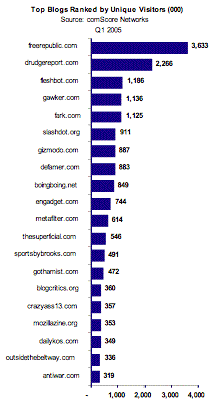

    Because comScore analyzed blogs by host, it separated the many that reside with big services, like LiveJournal, from standalone blogs, like Gawker, Engadget, or Kos. That’s an odd separation, since some category-leading blogs — like Atrios — also happen to be hosted on a big service. But with that methodology in mind, here is comScore’s analysis of the popularity of non-hosted blogs:

    Some demographic highlights:

    * Blog visitors are 11 percent more likely than the average Internet user to have incomes of $75,000 or more
    * Blog visitors are 30 percent more likely than the average Internet user to live in households where the household head is 18 to 34 years old….
    * In addition to being an attractive advertising audience demographically, comScore found that Blog visitors are significantly heavier Internet users than the average consumer. The average Blog visitor viewed nearly 16,000 pages over the course of the Q1 2005 – 77 percent more than the 9,000 pages viewed the average Web user. Blog users also spend substantially more time online. The average Blog visitor spent nearly 18,000 minutes or about 23 hours per week online, while the average Internet user spent just over 10,000 minutes or 13 hours per week online.

    Yes, indeed, this proves that blog readers have no lives.

    : Here’s Nick Denton’s analysis.< blockquote>There’s only one measurement that matters, however, to media buyers at the ad agencies. comScore found that, while 37% of internet users had annual household income in excess of $75,000, 41% of blog readers were in that top band.

    That may not sound like much of a difference. But based on their age profile alone, one would expect blog readers to be poorer: 32% are between 18 and 34, compared with 24% of the general internet population. Youth, with wealth, is, to advertisers, a rare and desirable combination.

    This conclusion alone should help persuade advertisers to shift more of their online budgets to blogs. Some of the more adventurous brands, such as Nike, Absolut and Audi, have experimented with blog advertising. And some marketers, such as the movie studios, have no choice but to follow their audiences online. But the vast majority of advertisers have been waiting for data. Here it is.
    Nick also reveals some of the stats from a separate breakout he commissioned on Gawker Media’s own blogs.

    : Here’s Fred Wilson’s tidbit about the frequency of blog visits to the social blogs sites, like LiveJournal.

    : Here’s a link to comScore’s release; you need to sign up to get the PDF.

    : Sorry that the charts are hard to read. Here’s a free link to the full PDF.

  • Blogvision

    Joi Ito does a blogcast on CNN about his op-ed and he’s amused that the CNN blog team saw his piece first not in print but in a blog (this one). I did similar blogcasts on MSNBC a few months ago, though the new smell has worn off that toy for them. FoxNews turned up its nose at the less-than-perfect broadcast quality (insert ironic joke and snicker here) when I suggested it more than a year ago. Now CNN is trying it out. Good. The smart network will realize that this is a new way to hear from new voices in no time at no cost. Someday, one of them will listen.