• The state of the art of news

    My response to the Project for Excellence in Journalism’s study that found most original reporting in Baltimore still comes from major media:

    No shit.

    We need a study to determine this? Well, maybe we do. I think it is worthwhile to have a baseline to compare where news goes in years to come. When I argued the need for an audit of news today with a Google News creator, he wondered why today’s news should be the starting point. My response: Only because that is where the conversation is, as in: “What are we going to lose?” So fine, let’s measure the value of what exists today and look at the resources that go into producing it (including the waste on repetition and commodification). So fine.

    But I think the study also brings some dangers.

    First, predictably, it only fuels the defensive passion of old media nya-nyaing the news, witness the NY Times: “But the study offered support for the argument often made by the traditional media that, so far, most of what digital news outlets offer is repetition and commentary, not new information.”

    Second, it defines news as news has been defined. We should be rethinking our definition of what is news — for many people, it’s not stories about juvenile justice, one of Pew’s subjects — and how it should be covered — not necessarily in articles — and how it is spread — that is the role of blogs and twitter — and not be stuck in old measurements.

    Third, it sets up a strawman and then lights the match: Do blogs give us most of our news? No, they don’t. Well, then, they must be worthless, eh? We’ll be lost without big, old media, won’t we? Just what we need. (Though to the study’s immense credit, it also notes how much of local news is repetitive and does not include original reporting.) “This study does suggest that if newspapers were to disappear, what would be left to aggregate?” Tom Rosenstiel, director of the PEJ, told the AP. There’s the strawman: Without papers, we’ll be without news. No, we at CUNY believe the market will deliver it more efficiently and perhaps — perhaps — more effectively. It may not be news as those papers defined it.

    We must keep mind that we are at the dawn, the very dawn of the new news ecosystem. There is no scalable business model in place — though, in our studies at the New Business Models for News Project at CUNY, we see them on the horizon and we see new companies starting to build it. When the Associated Press called me about this study on Friday, I said I knew of four dozen reporters in New Jersey who have left their jobs at newspapers and are dying to continue reporting in entrepreneurial startups and are waiting for the kind of help we envisioned in our project. Companies such as Impremedia and The New York Times are just beginning to consider their relationships with the ecosystem.

    We are also just beginning to see experimentation with the form of news, moving past the articles the study measures. News is becoming more of a process than a product; it is being disseminated in new ways thanks to search and social and algorithmic links. News is changing.

    So I’m fine to look at the PEJ as a historical artifact, a touchpoint for future discussion. But, for God’s sake, don’t consider it a write-off of that future.
  • Teaching entrepreneurial journalism

    On Friday, we at CUNY had the honor of playing host to a conference (call) for more than two dozen educators around the world — New York to Arizona to Berkeley to Guadalajara to London to Oslo — who are teaching or starting to teach entrepreneurial journalism.

    Here’s the wiki where we will continue to share syllabi, case studies, course materials, and videos. Here is a link to download the recording of the hour-long call (fast-forward past the howdys).

    We share similar but not identical goals. We all agree that it’s important for journalism students — and journalists — today to understand the economics of news. Some of us add that it was irresponsible of our institutions not to teach this in the past. We agree it is important to bring entrepreneurship into the industry. Some of us concentrate more on new entrepreneurial ventures, others more on bringing innovation into existing companies. Some say journalists aren’t cut out to be entrepreneurs (I disagree) but all agree that entrepreneurship is a way to teach both innovation and business. Some notes from the call:

    * At Arizona State, entrepreneurship is now a required course for journalism graduate students. AS emphasizes the need to get journalists to learn how to talk to people in other department and disciplines: how to work with engineers, especially. So AS gives student teams budgets for programming their projects; they’re looking at offering 5-10 hours per team for AS programming resources and 5-10 hours for programming resources teams find outside. They want teams to build but don’t want them to be tied to one platform. Cool, eh?

    * Larry Kramer at Syracuse asked about cooperation between journalism and business schools but on the call there were notes of caution. Business students, one said, aren’t there to be entrepreneurs; business school teach corporate culture, said another; and these business students also don’t learn media. Kramer wants to teach the Harvard Business School case method but is looking for cases written from the journalistic perspective.

    * Seek and ye shall find: Bill Grueskin of Columbia said the school has used a Harvard Business School case on the Norwegian wonder, Schibsted, and HBS will have another on Huffington Post. But HBS charges. Columbia created such a case on Politico and offered it to fellow faculty for free. Columbia also teaches a 60-minute MBA course and is putting that online.

    * David Westphal of USC talked about the pluses and minuses of teaching interdisciplinary classes with students from various pursuits; he said it’s worth the effort to get different perspectives.

    * Jay Rosen at NYU said he wants to get students to grapple with the entire problem of sustainability in journalism, putting it all on the table: journalism, audience, technology, business. He wants to “override the siloization of journalism.” He also said we need to work to attract different students who are entrepreneurially minded.

    * Jim Willse, ex editor of the Star-Ledger who’s teaching at Princeton this term, said we need to give scholarships to publishers to get them into entrepreneurial programs, to change their culture.

    * Many of us – Maryland, Columbia, CUNY – agreed that it’s important to have entrepreneurs and investors into class to expose journalists to their thinking.

    * For our part at CUNY, here is a report from my last entrepreneurial class (funded by the McCormick Foundation) and a description of how the class works. Here also are the new business models for news (funded by the Knight Foundation) that now inspire much of our work. Note that we just added a course in hyperlocal built around running The New York Times blog, The Local, in Brookyln. We are working with The Times and others to also tackle hyperlocal advertising opportunities and challenges (funded by the Carnegie Corporation); more on that as we progress.

    : ALSO: In Germany Ulrike Langer polls the journalism schools there — which operate in or close to media companies — to see what they are doing in entrepreneurial journalism and finds activity at those run by Burda and Axel Springer. (It’s in German.) Next call, we’ll have our German colleagues join us. If you know of such work going on elsewhere in the world, please let us know.

  • The death of a curious mind

    Deborah Howell was unafraid to learn in public. That, I think, is her best lesson for us all.

    Deborah died today in a roadside accident while vacationing in New Zealand. She had been ombudsman of the Washington Post, chief of the Advance Publications’ Newhouse News Service in Washington, and editor of the St. Paul Pioneer Press. She was 68.

    She and I worked together in various stages of our careers, most recently consulting for our former employer, Advance, in a daring project to fold the company’s 174-year-old newspaper in Ann Arbor and replace it with a an online service based on blogs and in the community. Our former boss, Steve Newhouse, paired us because I was to be the hot-air balloon — this project was, after all, a chance to practice what I’ve been preaching — and Deborah was to be the ballast, the traditionalist with experience in the eternal verities of journalism and respect from journalists.

    But our roles often reversed. I was the one holding Deborah down as she grabbed new ideas with the fervor of a convert and fretted that we weren’t being radical enough; I was cast by contrast as the conservative. She was quicker than I was to criticize and reject the work of traditionalists simply because it wasn’t good enough. She was open, eager, and fearless learning new technologies and their implications and opportunities. We brainstormed via wiki.

    That was a lesson for me. My prior interaction with Deborah had been as a blogger when she was the Post’s ombudsman. In that role, she found herself more than once in a hornets’ nest. She made a mistake and didn’t correct herself quickly or abjectly enough for bloggers’ taste. The paper killed comments about a controversy involving her, violating the bloggers’ sense of the propriety of a historical record. She found herself in the middle of the print-v-online war in the Post newsroom (which simmers still). I was among the critical. She never called me on it at a personal level. She stuck to the substance.

    Here’s Deborah rethinking the notion of blogging at a meeting of ombudsmen:

    Jarvis thinks all ombudsmen ought to blog. His blog is at https://buzzmachine.com. He said bloggers “distrust the institutional voice and trust more the human voice. The more we represent that personal voice, the better.”

    That caught me up short. I got a laugh at the meeting when I said, “I hardly have time to go to the bathroom. Start a blog?” Instead of responding to 600 letters, he said “a blog post is more efficient and adds to the conversation.” I’ll think about it.

    I learned that Deborah had little fear of learning. I argue that we must all learn in public now — which means making mistakes and finding lessons and moving on. We online need to be more generous with others as they learn our ways. There’s no sense in replacing one orthodoxy with another. What we need instead is curiosity. That is what Deborah had.

    Before the Post, Deborah was in charge of the Newhouse Washington bureau when I was the online editorial guy in New York and what I remember most about that time was her tireless, quixotic efforts to find a business model for the Religion News Service, which the company owned. Deborah fought for and protected this poor child the way she did all her journalists. That’s why they were loyal to her.

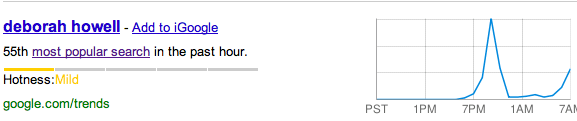
    I’ve long said that the only real fringe benefit to being a journalist is that you get an obit in the paper when you die. Lately, I’ve said I fear I’ll outlive the papers I worked on. But maybe there’s a new mark of a legacy. When I searched Google today for news on Deborah’s death, I found this:

    Picture 15

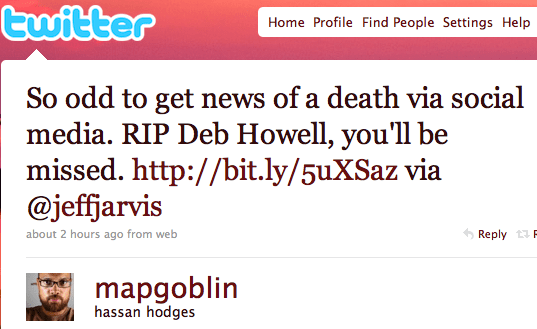
    Deborah’s friends and colleagues gathered around her new home online. And they spread the tragic news of her death and paid tribute to her:

    Picture 16

    Good-bye, Deb.

    : LATER: Here are David Carr’s and Ken Doctor’s remembrances.

  • Surrendering advertising … killing bundling

    Two things strike me about News Corp.’s battle to get cable fees:

    (1) Again and again lately, the company is surrendering the advertising battle. In newspapers, it is saying that advertising won’t support its high costs and so it will sacrifice traffic and advertising the hopes of building build pay walls. In MySpace, the company handed over its advertising fate to Google and then couldn’t produce. Now in TV — which is where Murdoch fils says the future of the company lies — they’re trying to eke fees from cable operators.

    (Under must-carry rules, a station can demand premium placement — which would benefit audience and advertising — or can demand a fee, but the cable company can decline to pay and carry the station. That’s the stand-off occurring now.)

    (2) News Corp. may succeed at getting fees from cable operators, but I predict that will raise prices for consumers as more and more fees are passed along; consumers will be further enraged that they have to spend money for bundles of channels they don’t want or watch; and that will give regulators the cause they need to demand a la carte pricing — which will end up hurting and likely killing second- and third-tier cable channels subsidized by bundles and wil hurt cable operators as they end up charging less.

    Add to this the paper-tiger nature of News Corp. threat to take Fox stations off cable. Oh, no, they taunt on crawls across the screen, you won’t get American Idol. Except we will, online, on Hulu, co-owned by News Corp. For News Corp. knows that the value of its own stations as ad vehicles is diminishing as the value of internet distribution rises. And so then this story comes full circle as News Corp. will likely threaten to charge consumers on Hulu — again, a capitulation in the advertising model.

    What we’re seeing is the disaggregation of another media form. We don’t buy albums; we buy singles. We don’t buy newspapers or magazines; we aggregate, curate, and link to the best stories we like, bypassing editors’ packaging. We don’t go to bookstores to get the books the system decides to put on the shelves; we buy what we want from Amazon. We listen to radio less and listen to our own playlists more (a trend that will only accelerate as we listen to new forms of radio on our phones). Now we will end up picking and choosing TV channels and even shows, diminishing the power network and station programmers’ and cable MSO’s hold over us.

    At the highest level, what we’re seeing is the death of the mass audience — and the value of distribution — and the advertising model that supported it.

    I don’t think advertising is dead. I think it’s dying for mass companies with high cost structures. Advertising will shrink, as Bob Garfield argues in the Chaos Scenario, and it will migrate to new media and new forms. News Corp. knows that; every media company finally does.

    So I think we’re seeing News Corp. milk the dying cash cow. Newspapers aren’t going to grow and will shrivel and sometimes die. The value of local stations is only going to shrink. (MySpace was a mistake.) So News Corp. is begging for cash wherever it can get it — from readers online or viewers on cable (via cable companies’ billing) — no matter that there’s no strategy there.

  • The annotated world

    Tweet: A view of our annotated world: Hyperlocal is what’s around me and how I search that

    There are eight million stories in the naked city and soon every one of them will be available on your phone through visual, aural, and geographic search and augmented reality in our newly annotated world.

    Every address, every building, every business has a story to tell. Visualize your world that way: Look at a restaurant and think about all the data that already swirls around it — its menu, its reviews and ratings and tags (descriptive words), its recipes, its ingredients, its suppliers (and how far away they are, if you care about that sort of thing), its reservation openings, who has been there (according to social applications), who do we know who has been there, its health-department reports, its credit-card data (in aggregate, of course), pictures of its interior, pictures of its food, its wine list, the history of the location, its decibel rating, its news…

    And then think how we can annotate that with our own reviews, ratings, photos, videos, social-app check-ins and relationships, news, discussion, calendar entries, orders…. The same can be said of objects, brands — and people.

    Thinking about Google’s synchronicity made me turn search on its head in my head. Rather than having to query a data base — how aughties that is – we will be able to point our phone — or whatever we call it — at anyone, anything, or anyone and get its story or ask about it or tell our own story about it. The challenge — which Google, among others, is attacking — is to organize all that annotation around the place, thing, or person.

    Local news organizations — if they were truly local — should want to do the same thing: organizing a community’s information so the community can organize itself. I call that, too, journalism. They are losing that opportunity to Google and Yelp (which this weekend was to be part of Google and then was not) and Foursquare — or at least they are losing the opportunity to work with and exploit what those companies are building, the next view of local. That’s the real definition of hyperlocal: what’s happening around me right now.

    Witness these videos (via the Digital Strategy Blog [in German]):

    About places:

    And where you are:

    And people:

    And (from me): things and the communities that exist around them:

    This is the new way I want to look at search: not to search a data base but to search my world, to see what is around me in new ways because I can.