• Page & Brin: Icons of the decade

    The Guardian commissioned me to write a piece on Google founder Larry Page and Sergey Brin as icons of the decade. My kicker:

    To understand the power of Brin’s and Page’s focus, go to Google’s home page now and type “weather in Ed” and stop there. Google will not only understand you want weather in Edinburgh but will give you the forecast right there in the search box; it will answer your question before you’ve even asked it. Google’s true holy grail is understanding, anticipating, and serving our intent.

    When we’re using Google devices with Google operating systems and Google browsers and Google software to ask Google questions in text or voice or even pictures and Google gives us each the personal answers we need from any source – no, the best source – in the world, in the context of the moment and our needs, that will be the culmination of the Google age. Google’s next frontier is not to organise the world’s information, but our lives.

  • Bankruptcy squandered

    Tweet: Here’s what I think bankrupt newspaper companies should be doing.

    The AP lists the status of six newspaper companies that have declared bankruptcy: Tribune, Freedom, Philadelphia, Sun-Times, Journal Register, Star-Tribune, representing 66 daily newspapers among them.

    Mostly they are using bankruptcy merely to restructure the debt they shouldn’t have gotten themselves into in the first place — the debt that nearly killed them. Often they are leaving in place vestiges of the legacy management that made those bad decisions and did not make the brave strategic moves the digital age demanded. Tragically, none of them has used the great if difficult opportunity bankruptcy gives them to reinvent their businesses and themselves, as I suggest here:

    Bankruptcy enables a newspaper company to shed its past. It can get out of contracts and leases for paper, printing plants, delivery, trucks. It can also get out of labor contracts, reducing severance costs. That is terribly painful but I fear it is as inevitable as the end of the ITU (the typesetters’ union). It offers a one-time chance to rethink, reinvent, and rebuild the company for the future. Is it better to stretch out the pain and never get anywhere? And if tough decisions and actions are not made, the likelihood that the company will die and all will be lost only increases.

    This is another reason I say that the future of news is entrepreneurial. Given the opportunity of market leadership and 15 years since the introduction of the commercial web and then, failing that given the opportunity of bankruptcy to change, the legacy institutions can’t bring themselves to do it for any of many reasons: It’s too expensive to change and cut back; it’s too painful to corporate valuation and ego built on size over profitability to reduce the scale of the company; it’s too difficult to shift the culture (especially after much of the best talent left with buyouts); the strategic vision just isn’t there. Whatever, the tale is too often told.

    Even so, it’s not too late for the legacy institutions. Perhaps foolishly, I refuse to give up on them. If these companies took just one or two papers each among their 66 to experiment with new models, to radically rethink and resize them and to learn instead of demolishing their old institutions brick by brick, they and their still-dying industry would be much better off; they might find a new way.

    I consulted on my former employer, Advance’s, project to do that in Ann Arbor, killing the Ann Arbor News and starting a new, blog-based, community-based company and service, AnnArbor.com; the industry should be watching and learning from it. That’s one model, but my no means the only one. Our work at CUNY in new business models for news (funded by the Knight Foundation) presents another vision, also not the only one.

    Before it is too late, I’d like to see these companies — especially companies still in or going into bankruptcy — try more models:
    * staying in print but splitting up the functions of the company and outsourcing everything possible;
    * investing in a widely distributed network of independent local and interest sites with the company adding value with curation and sales;
    * creating a pure ad network;
    * creating a very high quality product and — yes — charging a lot for it;
    * creating a series of special-interest niche services and, in some cases, publications;
    * creating the still mostly free but higher value craigslist with more curation for quality and more services;
    * experimenting with new services for local merchants — especially those too small to ever have afforded big, inefficient newspapers — including helping them succeed through Google, Yelp, et al;
    * creating citizen sales forces to scale while serving those small merchants;
    * what else?

    A few days ago, I had a related email discussion with John Paton, head of Impremedia, which rolled up a number of publications to become the largest Spanish-language publisher in the U.S. In the process, the company has made the difficult decisions to shrink by outsourcing and finding efficiencies and focusing and has changed its culture to put digital first. The industry should be watching these efforts as well. John asked why legacy companies are these days so often counted out in the discussion of the future of news. I recounted my views, above, and added that entrepreneurs have an easier time building from the ground up than big institutions do trying to rebuild from the top down. But I ended saying this: How can the legacy companies stay in the game? By acting like entrepreneurs, by bravely facing the new realities and by making bold moves to utterly transform themselves. It’s by all means possible. But it’s hard. And it’s rare.

    There’s still a minute before midnight to try.

  • Signs of hope

    David Carr wrote another good and hopeful column today (this, I told him, was his burning bush column). I’m delighted that it ended with a brief report on his jurying in my entrepreneurial journalism course at CUNY:

    Meanwhile, journalism schools are no longer content just to teach the inverted pyramid. A few weeks ago, I was at CUNY’s graduate school of journalism to help judge presentations from more than a dozen teams of young media entrepreneurs. There were some clunkers, as there always are, but there were also some scary good, real-world proposals from students who don’t have to think out of the box because they were never in one to begin with.

    I tried to be courteous and deferential, partly out of a small fear that I may work for one of them someday. There are worse places to end up.

  • Google’s synchronicity

    On the latest This Week in Google, we talked about many of Google’s product announcements and enhancements and though none on its own was earthshattering, as we added them up, I started to see synchronicity approaching — all the moreso last night when TechCrunch reported that Google’s negotiating to buy Yelp.

    I see a strategy emerging that has Google profoundly improve search by better anticipating our intent and then moving past search to build hegemony in local and mobile (which will come to mean the same thing).

    Add up Google’s recent moves in local/mobile:

    * Yelp would bring Google a scalable platform to get information and reviews about every local business using community. Yelp enhances Google’s place pages. Place pages enhance Google Maps. Google Maps are our pathway to local information on what we still mobile phones but will soon see as our constant connectivity devices.

    * Google distributed 190,000 QR codes for local businesses to paste on their front windows. Take a picture of it and Google will give you information about the place (see: above). Businesses have another reason to advertise on and be found through Google and its business center.

    * TechCrunch also speculates that we could use these QR codes to check in to Foursquare, Gowalla, et al. Local is social.

    * Google Goggles goes the next step and lets you take a picture of a place — or object (or soon, person) — and use that as a search request to get local information — or leave it.

    Thus Google becomes a doorway to the annotated world. Everyplace has information swirling around it; Google organizes it and motivates and enables us to create more information for it to organize (more on this idea of the annotated world in another post).

    * Google’s reported phone is said to have a “weirdly large camera.” If that camera becomes a key to visual search, that makes sense, eh? That also gives us a better way to take more geo-tagged photos, which better annotates the world and gives Google more information to serve back to us.

    * Google is trying to get better at recognizing speech to prepare for a voice-controlled (read: mobile) web world. That, say Chris Anderson and Tim O’Reilly, is why they give away GOOG411 for free: to learn our voices. And now note that Google is asking people to donate their voicemails to Google’s effort to improve its own transcription. Search will become visual and aural (read: mobile).

    * Google Earth is coming to the cockpit of the new Audi, giving drivers rich geographic data about where they are and where they’re going.

    * GoogleMaps on Android will now tell you what’s nearby.

    * Let’s not forget that Google will make money on local — Eric Schmidt said on CNBC a year and a half ago that Google will eventually make more on mobile than the web (which, to me, doesn’t mean phones; it means our constantly on connection devices). This is why Google bought mobile ad leader AdMob for $750 million.

    That’s mobile. Now look at some of its search enhancements to better intuit intent:

    * Go to the Google home page. Start typing “Weather in Lon” and stop there. Google will not only suggest that you want weather in London, it will give you the forecast for London right there in the search box. You didn’t even finish typing in what you wanted to ask and Google gave you the answer without you even having to click and go to a site.
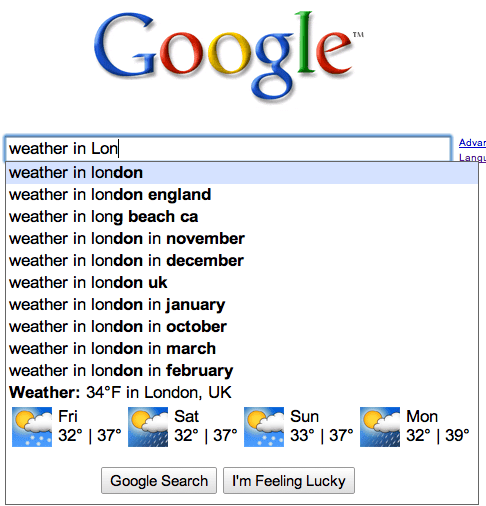
    Google search

    Google’s holy grail, they’ve long said, is to anticipate your intent. That explains, I think, some of Google’s other moves.

    * Google DNS is supposed to speed up the web for you (speed is a big Google cause these days) but it also gives Google an invaluable source of data about web usage: who goes where when and before and after what sites looking for what. Now, your ISP knows that. But with DNS, Google could know that. It makes Google smarter about the web and its content as a whole, certainly, and so long as it is careful about privacy, it can enable Google to target to us better.

    I see a day when search (like news) is no longer one size fits all. Search will be customized, personalized, and targeted to us and our contexts: who we are and where and when we are asking for something. This, I think, could mean the slow death of the dark art of SEO.

    * How will Google get us to use its DNS? Well, I’ll bet it will be the default in computers equipped with Google Chrome OS. And I wouldn’t be surprised of the Google Chrome browser can provide some of this data to Google.

    * Google launches social search. This creates more context and gives Google another clue to intent.

    Now add back in all the mobile developments above. This gives Google more context to anticipate our intent.

    But that’s not all. I’ve said for sometime that Google is behind in battles for the live and social web and was going to say here that it was bypassing those strategies to concentrate on mobile/local. But as I wrote the post, I saw more threads in both live and social.

    * Google added Twitter to its search results. That’s pretty much a BFD. But it shows they’re trying to grapple with the live web. And that’s why there are never-ending rumors about Google buying Twitter.

    * Wave is an important shift in the metaphor for content creation, making it collaborative (read: social) and live. Google added social tools to Google Docs. It make Docs a path to publishing (and being found via search) on the web. Creation itself is a social act once it enables us to connect.

    * Add in the social bits above: Yelp is a community tool; QR codes and visual search will let us talk about places and things and find each other and meet; Foursquare and Gowalla make local social and Google could help them.

    Last night, after the Yelp report, I tweeted this: “Yelp + GoogleMaps + StreetView + PlacePages + GOOG411 + Google Goggles + Android + AdSense = Google synchronicity”. Om Malik piped in: “@jeffjarvis I love your unrelenting belief in google. I think u need to start look at world in a non-search context.” But then I said – and others agreed: “I also think Google is starting to look at the world in a non-search context (i.e., local, live, mobile)”.

    I believe that’s what we’re seeing here: the start of Google’s view of itself after search. Not that search will go away but it will become less important in the shifting mix of out rings of discovery. And if search is going to stay preeminent, it had better update itself profoundly.

    : See also Gina Trapani’s excellent roundup of Google’s amazing 2009 developments.

    : LATER: Kara Swisher says Google is also eying real-estate search Trulia.

  • Google goes local

    TechCrunch reports that Google is in negotiations to buy Yelp. Makes perfect sense. Google is ready to make an assault on local with its Place Pages and QR codes on local establishments and augmented maps and directions and mobile…. This turf was newspapers’ and phone companies’ to lose and lose it, they will.

    Or as I put it in a tweet: “Yelp + GoogleMaps + StreetView + PlacePages + GOOG411 + Google Goggles + Android + AdSense = Google synchronicity”