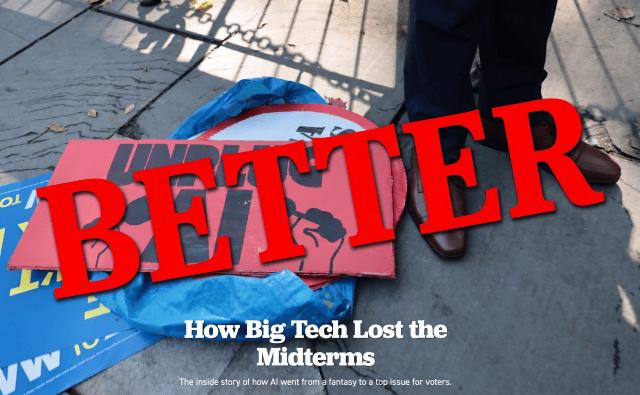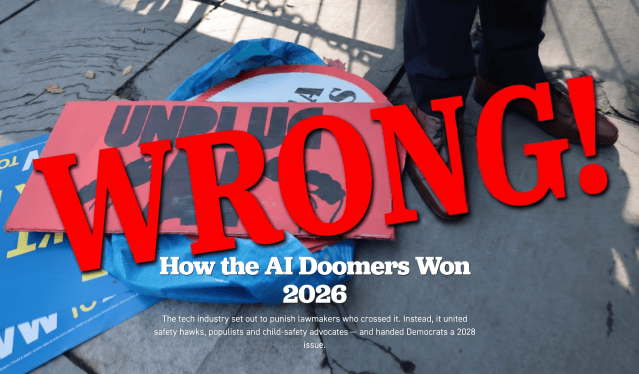
The subhed on that Politico story above gets the election right in crediting “safety hawks, populists, and child-safety advocates” who united to oppose AI companies and their data centers in the midterms. But Politico got the main headline terribly wrong. These are not “AI doomers.” AI doomers are the AI cultists who, paradoxically and illogically, claim their own technology could doom humankind — and that’s why they should be given unfettered control over it.
The doomers are the bad guys. But Politico’s headline said the bad guys won because that’s how these bad guys skew the language around AI and corrupt discourse about it. The result is that the top AI technologists and investors talk at 180-degree cross-purposes to media, policymakers, and the public. When they say “safety” it’s not how the rest of us define “safety.” Same for “regulation,” “humanity,” “doom,” even “future.”
Their intent is to confuse public discourse, and it works, making us think that when we say “safety” we’re discussing the same idea. We’re not — witness that Politico headline and too much credulous media coverage of AI.
So it is time to provide a helpful glossary contrasting the AI boys’ language with ours.
Future vs. “future”
What we mean: Next month, next year, next election, maybe next generation — time reasonably understood to be under our influence.
What the AI cultists mean: Their faux philosophers are no slouches. They work at Oxford — or worked; one of them, Nick Bostrom, was ousted with his Future of Humanity Institute when racist emails in his past were exposed. His fellow traveler, William MacAskill, wrote What We Owe the Future, published by Hachette, a textbook for the ideology they call Longtermism: that the future that matters is whatever affects the 10-to-the-54th future human beings yet to come. Their implication is that what bedevils us in the present — whether injustice or inequity, plague or Holocaust — pales in comparison to anything that would hinder the happiness of all those future beings.
These technocrats are utilitarians who contend they can calculate and affect total happiness. That is what leads to such noxious thinking as this from one of their number: Here, a New York Times profile of Anthropic cofounder Dario Amodei perfectly illustrates the poison fruit of Utilitarianism.
In a blog post for GiveWell that year, Dr. Amodei discussed a decision to give away $10,000. He was choosing to donate to either the Stop TB Partnership, which focused on preventing adult tuberculosis, or VillageReach, which helped vaccinate children in African villages.
The Stop TB Partnership, Dr. Amodei wrote, was superior in “cost-effectiveness” because it served adults and “adults are capable of deeper and more meaningful experiences” than infants. “I think an adult death is perhaps 2 or 3 times worse than an infant’s death,” he added.
He thinks he can judge which humans are more valuable. That is the bridge that connects Utilitarianism and Longtermism to eugenics: the making of the Übermensch.
Human vs. “human”
What we mean: Us.
What the AI cultists mean: They mix the tenets of technology and philosophy, claiming they can use computers to build better humans — that indeed, human and machine will merge and become one in what they call the singularity. That is their doctrine of Singulatarianism.
Their quest begins with the chips that cultist extraordinaire Elon Musk wants to implant in heads, leads next to the humanoid robots Musk plans to sell (instead of his punchline-on-wheels, the Cybertruck), and ends with the belief that human psyche can be uploaded to machines and live forever and everywhere.
That encapsulates their belief in Extroprianism: that the mind can transcend the limits of the body. It also speaks to their version of a philosophy called Rationalism: when future humans think not like the base animals we are but instead rationally, like, well, algorithms. When the AI boys build what they call neural networks, some think they are building brains.
And that is how Bostrom gets to his magic number of 10-with-54-zeroes future human beings. They’re not like us. They’re not us. They are humans as machines, machines as humans, better than us: Übermaschinen.
Environment vs. “environment”
What we mean: Our dear Earth.
What the AI cultists mean: The universe, which they contend they can and will colonize with their human/machines. That is why Musk obsesses about Mars. This is called Cosmism.
Altruism vs “altruism:
What we mean: Unselfishly thinking and generously acting on behalf of others’ needs.
What the AI cultists mean: You’ve no doubt heard of “effective altruism” (EA), another of the AI cultists’ philosophies. This one was made infamous by Sam Bankman-Fried, convicted crypto fraudster and proponent of EA.
In the beginning, EA sounded reasonable enough, motivating the well-to-do to focus their charitable generosity on acts that will cause the most good. The example always used is buying mosquito nets to save lives. Who can nitpick that?
Ah, but when you follow this Utilitarian string — maximizing good — to its extreme, mixing in other of these zealous philosophies along the way, you throw out the mosquito nets and the African children saved by them in favor of investments that will benefit Bostrom’s Übermenschen: technologies like superintelligent AI. These effective altruists believe they know best how to invest society’s wealth and so they should have more of it. These altruists aren’t so altruistic after all; they are greedy money-grubbers and this is their wealth gospel.
Doom vs. “doom”
What we mean: ’Bye, all.
What the AI cultists mean: Their machines will become so intelligent, so powerful, so uncontrollable that they can destroy humankind. This is the thesis of Bostrom’s famous paperclip scenario, in which machines told to make nothing but paperclips will turn every resource on earth into paperclips, never mind humans’ needs for energy and oxygen: Clippy’s revenge.
There’s another variant on Doomerism from its primary prophet, Eliezer Yudkowsky, coauthor of the Doom bible, If Anyone Builds It, Everyone Dies: Why Superhuman AI would Kill Us All (also cynically published by Hachette). Cheery fellow. He loves the idea of superhuman AI but fears that if it is built badly and backfires, it could destroy humankind before it serves Bostrom’s future beings. Thus Yudkowsky says all AI should be stopped until we’re ready, else it should be destroyed with thermonuclear weapons so the remaining humans can learn their lesson and pick up work when they’re ready. This he calls safety.
Safety vs. “safety”
What we mean: Since the seminal Stochastic Parrots paper in 2021, AI safety has been clearly defined, focusing on harm to the environment (resources and climate), economy (labor and cost), public discourse (bias and disinformation). It is not complicated; so clear AI can grok it. I asked AI (Gemini) to summarize the paper’s definition [its emphasis]: “For the authors, ‘AI safety’ is not about preventing an autonomous AI takeover; it is about preventing real-world harm to human beings — especially marginalized populations — caused by irresponsible data practices, resource consumption, and the uncritical deployment of large-scale statistical models.” Right.
What the AI cultists mean: If we take all the related isms I’ve mentioned thus far — Transhumanism, Extroprianism, Singulatarianism, Cosmism, Rationalism, Effective Altruism, Longtermism — and put them together, it spells TESCREAL, an acronym coined by Stochastic Parrots coauthor Timnit Gebru with Émile Torres. Here is their paper that explains these faux philosophies and their roots in eugenics.
And that is what makes up the foundation of the AI cultists’ definition of safety: managing the all-powerful AI they are building so it does not, one way or another, destroy humankind. Safety to them has nothing to do with environmental damage, childhood safety, or disinformation. It’s all about doom.
This bit of dictionary disarray comes home to roost in media coverage of AI “safety,” as when The New York Times reports on a gathering hosted by the Future of Life Institute (FLI) that attracted odd bedfellows Bernie Sanders and Steve Bannon — without once mentioning that FLI is funded by known doomers and that “safety” went undefined. Through such coverage, the doomers — AI boys of one stripe or another — gain legitimacy.
The same problem arises when some employee leaves an AI company to supposedly blow the whistle on a lack of attention to safety there. We think they mean safety in our definition and reporters never ask them to define it. If they bothered, they’d find that often these departees are doomers.
Media and policymakers are blind to the cultists’ dangerous nuttiness because they successfully hide behind virtuous words — safety, altruism, and regulation — whose meanings they have hijacked and mangled.
Regulation vs. “regulation”
What we mean: Government intervention in an industry or activity to ensure a mandated level of transparency and accountability to the public good.
See, for example, Mallory McMorrow’s proposal to regulate AI, calling for transparency and testing, export controls, and humans in charge. We can and should debate the particulars, but that is a sane starting point.
What the AI cultists mean: The so-called frontier AI companies — Anthropic and OpenAI — say they favor regulation. But in their plan, this means they write the regulations to favor themselves and exclude start-up and open-source (open-weight) competitors. This is classic regulatory capture.
They also tout their self-regulation, with Anthropic putting forth its “constitution” for AI, asserting that they can make machines (which can’t count the Rs in “strawberry”) operate according to high principles. OpenAI has proposed frankly naive plans for world bodies to oversee AI.
Some AI boys, led by VC Marc Andreessen, are accelerationists. They believe any regulation hindering the progress of AI is evil. As Andreessen wrote in his breathless techno-optimist manifesto: “Technology is the glory of human ambition and achievement, the spearhead of progress, and the realization of our potential…. We can advance to a far superior way of living, and of being…. We believe intelligence is the ultimate engine of progress. Intelligence makes everything better…. We believe Artificial Intelligence is our alchemy, our Philosopher’s Stone — we are literally making sand think.”
The serious problem with all the definitional disconnects I’ve outlined here is that without agreement on what harm is to be mitigated, it is impossible to hold a meaningful debate over how to regulate it, how to hold its makers and users accountable while sharing the fruits of this impressive technology.
Intelligence vs. “intelligence”
What we mean: Don’t know. That is why the first book I commissioned for the Bloomsbury series I am editing, Intelligence: AI & Humanity, is by Dr. Rumman Chowdhury, who will examine this human construct in the context of history, where it has been used to exclude and has inspired a mania to measure what remains an abstract concept. To my mind, intelligence is that which defines humanity.
What the AI cultists mean: They think it is easy not only to define intelligence but to build it and set benchmarks for it. Not just that, they think they can build machines that will beat human intelligence by any measure. They call this Artificial General Intelligence (AGI)— general in the sense that it can do anything we can do — or Artificial Superintelligence (ASI) — super in the sense that it can do all that better than we can. The frontier companies headed for their trillion-dollar IPOs say they’re nearly there, that their generative AI chat machines will soon be so damned smart they can build and improve on themselves.
OpenAI’s Sam Altman and others in the field treat intelligence as a commodity their companies can make, own, and sell, as if from a vending machine. That is their utmost dehumanization of us all.
There are AI people who are not in the cult, thank goodness. One I admire is Yann LeCun, who believes that language-based generative models will take development of AI only so far. He favors real-world models that learn the laws of physics and are built for and limited to specific, controllable functions, rather than becoming the everything machine. He also is an advocate of open-source, open-weight AI to spur competition and innovation. Another proponent of world models is Fei-Fei Li.
I wish scientists and contrarian builders like LeCun would get more attention in media coverage of AI. I wish scholars like Gebru would be called upon to give audiences context on the outlandish claims of the AI boys. I wish journalists would press those AI boys on definitions inherent in those claims. I wish they would stop allowing the boys to anthropomorphize their machines — as if they have motives and morals — and stop doing so themselves. And when writing about AI, I wish they would discard the AI boys’ dictionary in favor of Webster’s.
This American election was indeed a repudiation of AI and its data centers. But I say data centers are merely the McGuffins of the drama — that is, tangible symbols of the actual objects of dislike and distrust: the AI oligarchs and billionaires who wield their wealth in our elections, who threaten to destroy humankind (and demand the power to do so), who are generally jerks, and who maim the language to obfuscate their own intent.
I think AI is an amazing and promising technology whose opportunities we have just begun to explore. I cohost two podcasts about AI (Intelligent Machines and AI Inside) and, as I said, I’m editing a book series to bring the humanities into the discussion about it. But I say the wrong people are in charge of this technology, and those people are conning the journalists and politicians who should see through them to stop them from ruining it for us all. Start with clear language.
As I finished writing this, I returned to Politico and found that the editors (or A/B testing or AI) thought better of the headline above. This is how a later version read: