Here are my probably contrarian views of Good Night, and Good Luck, the beautifully made movie about Edward R. Murrow’s confrontation with Sen. Joseph McCarthy:
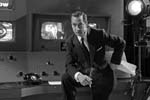
As courageous and laudable as Murrow’s stand against American tyranny was – and it was – I also wonder whether it helped lead to the downfall of Dan Rather, the downsizing of CBS News, and perhaps even the decline of mainstream journalism itself.
For Murrow’s triumph led to a half-century-long era of haughtiness, self-importance, and separation from the public in the news. That may not be his responsibility – though he is shown at the start and end of the film dismissing the decadence, escapism, distraction, and amusement of television and America’s mass tastes (either out of snobbery or more likely out of shame, since he, too, catered to them on his own celebrity slather show). His disciples came to believe that the wattage of their broadcast towers entitled them to equivalent power in society. They thought they were no longer hacks looking out for the common man – as common men themselves – but instead the saviors of society (and rich ones at that). They were the ones who dubbed themselves the Tiffany Network. They thought they could do no wrong.
And then along came Dan.
Ain’t Edward R. spinning in is grave now?
These founding fathers of TV news could convince themselves of their invincibility because they came into journalism just as television itself destroyed competition in local newspapers and established an age of monopoly news, of one-size-fits-all mass media, of fewer voices and less diversity of views. And so CBS News pulled the rest of TV – and print journalism, too – up on a pedestal, above it all. The age of the oracles began, an age that – thanks to the internet – is just now ending, as declared by no one less than the current president of CBS News, Andrew Heyward.
Isn’t that ironic: The most mass medium in history gave birth to a class of media snobs. And the until-recently-exclusive medium (for the technologically sophisticated at the start) cuts them down to earth and once again empowers the little guy.
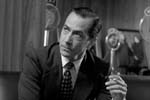
It’s equally ironic that after Murrow, we also came to find ourselves wrapped in an ethic of objectivity in news. Murrow was hardly objective, not in his finest moment. He was highly opinionated. He was on a crusade, God bless him. Yet soon after his triumph, we came to believe that objectivity was the highest virtue of journalism and of journalism school.
I’ve long ascribed that idolotry of the objective to our one-size-fits-all marketplace of media, from the mid-’50s to the mid-’80s (when the remote control reached 50 percent penetration in America) and beyond: If you had to be everything to everyone, you tried to offend no one and serve no side over another. It kind of made sense, given the circumstances.
But in the film, I think I got a glimpse of another root of the objectivity era. Murrow’s CBS News colleague and friend, Don Hollenbeck, was himself under whisper attack by the blacklisters and a dark, conservative Hearstian columnist: a proto’reilly. He committed suicide under the pressure.
And then they started talking about how the news was or was not slanted. The critics accused the journalists of slanting and the journalists denied it – the self-same journalists who had just slanted bravely against McCarthy and his fellow travelers. It struck me as a certain sort of pandering to the pressure: Instead of proudly standing up and saying, you bet we’re biased in favor of that little guy and against the tyranny of power, they cowered and said, ain’t no slanters here, just us chickens.

As much as I celebrate the exploding of media monopoly via the internet, Good Night did make me wonder whether we might end up longing for the power of the huge platform, for that power allowed Murrow to stand up to McCarthy and survive and help put the nation back on its democratic course. Well, he didn’t do it alone. But the power of major, mainstream, mondo, monopoly media helped, didn’t it?
In our new, distributed world, we have to re-aggregate ourselves into a powerful chorus of voices. We don’t have Cronkite finally disapproving of the Vietnam war. We have Porkbusters instead.
I don’t think I’ll miss the overpowering platform. But I wonder.
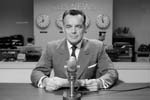
Another thing the monopolization of media did was insulate journalism from the pressures – and wisdom – of the marketplace.
That, I think, has proven to be every bit as damaging as the haughtiness. And this may, indeed, be Murrow’s fault. For we hear him lecturing CBS founder Bill Paley that news should not be subject to business realities.
We hear that same refrain today when reporters whine about cuts in the newsroom even as newspapers suffer the loss of audience – who no longer like or need their product – and of classified, retain, and circulation revenue, which have fled to better marketplaces elsewhere. If newsrooms had been more attuned to their marketplaces – not prostituting themselves, just listening and serving – they may have tried to update news and not leave it as it was that half-century ago.

If we take the atmosphere of the film as accurate, it’s striking how much the nation has changed, how much fear has stopped dominating public life. The reporters and the people were afraid not just of McCarthy but of government: of senators and the FBI and the military. And the people also feared the reporters: Murrow and company anxiously awaited the criticism coming out in the papers’ first editions; Hollenbeck killed because of the power of the press.
Today, we ridicule government and dismiss the power of the press. We have come a long way, baby.
And though the movie tries to draw parallels with today – “We cannot defend freedom abroad by abandoning it at home,” Murrow preaches to ironic (Iraqi) cackles in the New York screening room – it’s hard to paint red-baiting and terrorist-hunting with the same brush. For many reasons – some ethnic, some religious, some politically correct – we’re not likely to fear our neighbors wondering whether we are now or have ever been a member of al Qaeda or an Islamic fundamentalist fascist.
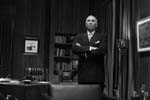
It so happens that I ran into my friend Nick Denton, founder of Gawker Media, and dragged him along to the screening (yes, they’re inviting bloggers to screenings) of Good Night.
The dramatic parallels are just too beautiful to pass up: I was watching the invention of one electronic medium as we live through the invention of the next. Nick had just finished saying that a reporter who wrote an article on the phenom he denies founding missed the real angle of the story, namely: “We don’t give a fuck.” And then I saw on the screen the genesis of journalistic haughtiness, which was very much about giving a fuck. I complimented Nick on the barbed and blunt coverage, of sorts, given Bush’s latest Supreme Court nomination by Wonkette: hardly fearless, just fearsomely snarky. And then I saw the journalists on screen refuse to cower under government’s power.
Yes, you could cut the irony – just like the smoke on the screen – with a knife.
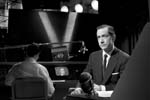
This isn’t a movie review but if it were, I’d tell you to see Good Night, and Good Luck. I’d blurb it. This is a compelling story of courage and a brilliantly produced period piece that portrays its heroes with both admiration and wit. And though there are a few grandstanding speeches, there could have been more. David Strathairn as Murrow is remarkable and so is Clooney as the film’s producer. My grade: B+