Tag: Ad

  • The numbers

    Two people I respect tweaked me — one in a post, one in email (both with a business interest in the matter) — for what I wrote about the comScore kerfluffle (or efforts to start one). I think they misread me but that probably means I miswrote it, so let me restate to be clear:

    First, I am delighted that we have the comScore research. I think this is incredibly important in the growth of blogs as a business — for those who want it to be a business — for this states their metrix in terms that advertisers will respect and understand… and buy. Remember that I pushed very hard for such research to be undertaken at Bloggercon II.

    Second, the things in the results that don’t sound sensible can probably be corrected with improved methodology and I hope that comScore is smart enough to call upon the expertise of this open world to help them improve that methodology. Fred asks for Jason to hand over his server logs to help them and he asks for time and he’s right:

    The issue with panel research is you need time to develop the statistical algorithms that weight the panel data correctly before you scale the numbers. And you need a very good dictionary of the domains you track. These take time to nail down. Clearly Comscore hasn’t nailed it yet, but they never said they had.

    But third, even with the best study, I stand by my point that panel research — as valuable and necessary as it is for advertising to be able to judge an even playing field of properties — is at the end of the day still bullshit. Fred argues:

    Jeff is so wrong about this that I find myself shaking my head on this one.

    First, the problem with panel research of old is small sample sizes. The panels that have been used for decades in old media are almost always less than 100,000 people primarily because it is cost prohibitive to collect data from a larger panel. Clearly that is way too small for accurate measurement.

    But Comscore invented the concept of a “megapanel” in 1999 and is currently measuring over 2 million unique Internet users. That’s the beauty of the Internet, you can measure online at a scale unimaginable offline. At that kind of scale, panel research is not only accurate, its amazingly accurate. As far back as 2001, Comscore was able to predict a missed quarter for Amazon.com. And the panel size and the technology have improved significantly since then.

    Well, I spent years in publishing and then the internet seeing how wrong panel research could be. People magazine allegedly had
    eight readers per copy
    according to panel research. On the face of it, that’s absurd. But it determined the readership and thus cost per thousand and thus ad rates for People. And that paid my salary. But it was bullshit. And everybody knew it.

    Online, I saw these big panel studies rate some of my smaller sites as huge and some of my biggest sites and nonexistent. And the reason for that, clearly, was that the sample didn’t have people clicking on mice in Ratbutt, Alabama. The problem is that when you measure small things — and blogs, individual blogs, are still very small — the effectiveness of a sample panel will decrease exponentially and the impact of one reader or one missing reader can be amplified to ludicrous extremes.

    My fourth point is that, yes, I agree with Fred that Jason should take a deep breath and get over it and others who nitpicked the study should take it in the context of all such studies: They are all bullshit, so untie those knotted knickers and move on.

    For, yes, this is an important study. It shows that blogs are big and growing. It shows the relative size of their audiences against other media properties and makes them real. It starts to give advertisers (and us) the flavor for the unmedium — our interests, our habits (e.g., political blogs get more traffic from smaller audiences), our demographics, and all that.

    So what I’m really saying — though, clearly, I said it badly — is that the details and the nitpicking and the fact that it’s just bullshit doesn’t matter and so it’s not worth fighting over, especially if it can be improved. This is what advertisers need. This is what will make them buy.

    My fifth and final point is that we would be foolish to stop at this kind of syndicated research as the basis of building blogs as a business, for — just like Google AdSense — it devalues and misjudges us. We have greater value in our relationships and influence and we need to find ways to measure that. No, that is not a substitute for the basic audience metrics advertisers demand. But it will prove our higher value and we can then get paid for that higher value and that is a good thing.
  • Numbers don’t joke

    Jason Calacanis is having proper conniptions over the comScore marketing study on blogs released this week. Fred Wilson and Heather Green have moments of dubious doubt themselves. Krucoff, says Jason, nails it and quizzes Rick Bruner, who helped on the study itself, as Rick tries to answer questions on the methodology on his blog. I leave it to you to follow the links above to the specifics.

    My first reaction is that all this shows how messed up panel research is. This is the method used by Nielsen et al to measure TV and radio and print readership — affecting billions of ad dollars — and it is and always has been relative bullshit. That’s why advertisers buy it, though — because it is relative, because they can compare this magazine to that magazine on the same sheet. But it’s all based on a small and only allegedly representative sample of people. It’s meaningless. When I worked on magazines that allegedly had eight readers per copy — damned dogeared, they were — we benefited from this relative bullshit. But when I came online, we could measure the bull ourselves: We could compare our server and cookie stats with what the panel research told us and we could tell when they didn’t have any panel members in entire states. Panel research is a novel in numbers.

    My second reaction is, however, that blogs need some sort of numbers advertisers will buy. I thought it was a good idea to try to get that research and, as I read that link, I see that this is partly my fault: At the blogging business session I emceed at Bloggercon II, I emphasized the need to feed advertisers their metrics. So it’s a damned shame that this research is raising such eyebrows.

    My third reaction is that we should be creating our own meaningful metrics. Bloggers who care about making business at blogging (and let’s remember: that’s only some of us) should be agreeing on cookies and also on new means of measurement and new things to measure.

    This isn’t as simple and stupid as an a-list or a panel or page-views or eyeballs. This is a much richer thing, this unmedium of ours, and it needs much smarter measurement. See Mary Hodder’s napkin notes for just some of the means of measuring blogs’ popularity and appeal; I can think of many more.

    Advertisers are screaming for proof of “engagement” these days and while silly, inky magazines are trying to “engage” with flashing ads on paper, we flash without trying. We engage or die. We live by relationships and trust — more fave ad words. We have influence — yet another fave word. We need to measure and report all that.

    Instead, we’re futzing and fussing and fuming over the few numbers we have and giving advertisers another excuse to ignore us. Arrgh.

    comScore should reveal much more about its study so that bloggers can poke at it and so the crowd — the wise crowd — can help improve the methodology and ferret out what makes sense and what doesn’t — and let’s remember that these numbers do show that blogs are a thing that should not be ignored. If something looks odd, explain it or explain why you can’t.

    And we should start finding new ways to measure our real value — and that’s not about continuing to chase the big numbers that are so old-media and it’s not about continuing to value relative bullshit. We need to find the numbers that count.

    : Oh, and while we’re at it, can somebody point me to exactly what the oft-quoted and bragged-about Alexa numbers are really based on? Does there data come from the toolbar still? Do you know a single soul who actually uses that toolbar? How big is their sample? How representative?

    Every one of these services that now tout numbers should be transparent about methodology and sources and scale. It’s late, so I’m not going to go looking now. But if you can point me to such disclosure at Blogpulse, Technorati, Bloglines, et al, please leave a link in the comments and let’s start by finding the best of breed in transparency.

  • Exploding advertising

    Here are a few news items that reveal the real change occurring to newspapers and it’s not in the newsroom: It’s in the advertising department.

    But note well that these changes also have a big potential impact on Google if it doesn’t pay attention (and Google is getting awfully big for its britches).

    Quigo announced deals with 130 newspapers to open up ad avails on their sites for auctions…

    …turning each site into an auction marketplace where ad placement is up for grabs….

    Michael Yavonditte, CEO of Quigo, said, “We’re beginning to see a radical shift in the way newspapers are assessing the competitive landscape of content and online advertising. They’ve quickly grasped the idea that it is the newspapers, not the ad network, who should own the advertiser base. Our auction-style pay-per-click is a great way for the newspapers to become relevant to their local advertisers who have been buying keywords from Google and Overture for years now.”

    In short: Newspapers will compete with Google’s AdSense and try to grab the auctioned pay-per-click advertising that is going there. Newspapers are trying to hold onto local in this new ad universe. They are also hoping to grab new advertisers at a lower cost: The bet in hyperlocal is that the small advertisers who could never afford newspapers could now take advantage of ads that are affordable because they are highly targeted and have next-to-no cost of sale and production. Will these ads replace revenue lost in classified? Will advertisers leave print retail for online hypertargeting? What will the total revenue of papers look like in this new world? Who knows?

    Separately, read Fred Wilson on his investment, along with The New York Times Company’s [see my Times full-disclosure here] in job search site Indeed.

    So, why did we make this investment, beyond the fact that this was one of the sectors that has always interested us?

    For one, we are big believers in the fragmentation of the Internet. We don’t believe that there are going to be several large “destinations” where employers will go to list their jobs in the coming years.

    I’ve been beating that drum for well more than a year now: With search and tagging, buyers and sellers can be anywhere on the internet and can be found and put together; when you bring organization to our new, distributed world, the need for centralized marketplaces fades. (More on this, probably later today.)

    We are a believer in what some of us are calling “sell side advertising”. That’s the idea that advertisers will put their ads on the Internet for anyone to find and display. And if the advertiser gets clicks back, they will pay for the clicks.

    Been banging that drum, too.

    Job search is one of the first places that sell-side advertising is going to happen because most employers already put the jobs they are currently looking to fill on their web sites. Those jobs are the “sell side” ads. Indeed and others are crawling the Internet, grabbing those “ads” and displaying them.

    For newspapers, it’s already clear that the classified marketplace is being replaced. But this also has big mplications for Google. Last drumbeat: I’ve been arguing that specialized search engines — organizing and taking advantage of the distributed world via tagging structure — will do a better job than Google in their areas (perhaps even riding on top of a Google API).

  • Measuring us

    comScore Media Metrix just released the first major marketing study of the blogging audience — a study in the format and from a source advertisers will pay attention to. The study, cosponsored by SixApart and Gawker Media, used comScore’s consumer panel — that is, surveys with people instead of cookies and server stats — to find out who visits blogs at 400 domains (including big ones, such as LiveJournal, Blogger, and Typepad and others that get onto such lists as Technorati’s). Among the findings:

    • 50 million U.S. Internet users visited blog sites in the first quarter of 2005. That is roughly 30% of all U.S. Internet users and 1 in 6 of the total U.S. population
    • Five hosting services for blogs each had more than 5 million unique visitors in that period, and four individual blogs had more than 1 million visitors each
    • Of 400 of the biggest blogs observed, segmented by seven (nonexclusive) categories, political blogs were the most popular, followed by “hipster” lifestyle blogs, tech blogs and blogs authored by women
    • Compared to the average Internet user, blog readers are significantly more likely to live in wealthier households, be younger and connect to the Web on high-speed connections
    • Blog readers also visit nearly twice as many web pages as the Internet average, and they are much more likely to shop online

    comScore says that blogs are now big media. I actually wish they didn’t try to measure this broad, distributed world in the old, concentrated terms of media but, hey, old habits die hard. They found that this year’s blog audience…

    …represents an increase of 45 percent compared to Q1 2004. While it’s difficult to define where the threshold lies for “mainstream media,” one could argue that with approximately 30 percent of the U.S. Internet audience now visiting blogs, this medium is quickly approaching that status….

    Traffic to the top blog hosting services has grown considerably in the past year. The top four hosts each now reach more than five million visitors per quarter. In fact, Blogspot.com now reaches more visitors than NYTimes.com, USAToday.com and WashingtonPost.com — clear evidence that consumer-generated media can draw audience on par with traditional online publishers.

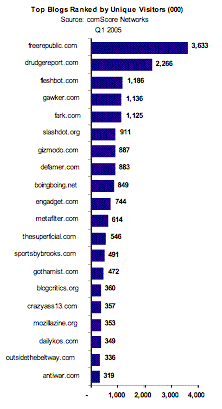
    Here is comScore’s list of top blogs as measured by unique audience — by reach, as advertisers like to say:


    Because comScore analyzed blogs by host, it separated the many that reside with big services, like LiveJournal, from standalone blogs, like Gawker, Engadget, or Kos. That’s an odd separation, since some category-leading blogs — like Atrios — also happen to be hosted on a big service. But with that methodology in mind, here is comScore’s analysis of the popularity of non-hosted blogs:

    Some demographic highlights:

    * Blog visitors are 11 percent more likely than the average Internet user to have incomes of $75,000 or more
    * Blog visitors are 30 percent more likely than the average Internet user to live in households where the household head is 18 to 34 years old….
    * In addition to being an attractive advertising audience demographically, comScore found that Blog visitors are significantly heavier Internet users than the average consumer. The average Blog visitor viewed nearly 16,000 pages over the course of the Q1 2005 – 77 percent more than the 9,000 pages viewed the average Web user. Blog users also spend substantially more time online. The average Blog visitor spent nearly 18,000 minutes or about 23 hours per week online, while the average Internet user spent just over 10,000 minutes or 13 hours per week online.

    Yes, indeed, this proves that blog readers have no lives.

    : Here’s Nick Denton’s analysis.< blockquote>There’s only one measurement that matters, however, to media buyers at the ad agencies. comScore found that, while 37% of internet users had annual household income in excess of $75,000, 41% of blog readers were in that top band.

    That may not sound like much of a difference. But based on their age profile alone, one would expect blog readers to be poorer: 32% are between 18 and 34, compared with 24% of the general internet population. Youth, with wealth, is, to advertisers, a rare and desirable combination.

    This conclusion alone should help persuade advertisers to shift more of their online budgets to blogs. Some of the more adventurous brands, such as Nike, Absolut and Audi, have experimented with blog advertising. And some marketers, such as the movie studios, have no choice but to follow their audiences online. But the vast majority of advertisers have been waiting for data. Here it is.
    Nick also reveals some of the stats from a separate breakout he commissioned on Gawker Media’s own blogs.

    : Here’s Fred Wilson’s tidbit about the frequency of blog visits to the social blogs sites, like LiveJournal.

    : Here’s a link to comScore’s release; you need to sign up to get the PDF.

    : Sorry that the charts are hard to read. Here’s a free link to the full PDF.

  • But who will pay me for suffering through Will Ferrell’s last three movies?

    Sony just settled a lawsuit brought by moviegoers tricked into seeing a crappy film by a blurb in a movie ad from a nonexistent critic. Members of this classless action lawsuit can get a $5 refund per ticket.

    When I was TV critic at People, I gave a bad review to some bad TV show and NBC pulled a quote out of context: I said something to the effect that it was an incredible piece of crap and their ad said, “Incredible! – Jeff Jarvis/People.” I wrote about this in my next column, complaining about the “NBC pinhead” who’d done this dishonest deed.

    Now this happened to be during the development of Entertainment Weekly. And it so happened that my alleged business partner went to Hollywood for meetings to flog the idea of the mag. When he returned, I asked how the meetings had gone and he said that his meeting at NBC was with “the pinhead.” The biz guy was uncomfy. I said welcome to the world of church and state.

    And Hollywood wonders why it’s shrinking. They make crappy movies and then lie about them. [via Freakonomics]