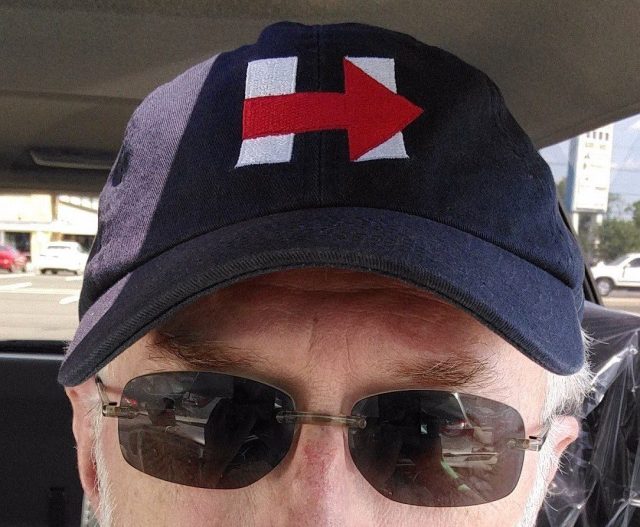
It is journalistic heresy that I abandon the myth of objectivity and publicly support candidates. But the advantage of heresies is that they open one up to new perspectives. By seeing my profession and industry from the viewpoint of an interested voter, I get a new window on the failures of news media.
People know that I support Kamala Harris for president and so these days they’re asking me whether I’m still for her because, you know, the polls. Inside, I scream and deliver a searing lecture on the tyranny of the public-opinion industry, on the true heresy of journalistic prognostication, on the death of the mass, on the devaluing of the franchise of so many unheard voices in America. Outside, I just smile and say “you’re damned right, I do,” and wait to get to my desk pour out that screed here.
The coverage of Kamala Harris’ campaign is a classic case of media’s self-fulfilling prognostication. Step-by-step:
- Harris’ campaign opens with a big rally and reporters say she could be bigger than Obama! Thus media set expectations the candidate did not set.
- A parade of white men with established recognition (read: power) enter what had been a wonderfully diverse field, splintering the vote.
- Harris’ poll numbers decline. Media declare disappointment against media’s overblown expectations.
- Media give less attention to Harris’ campaign because, you know, the poll numbers.
- Harris’ poll numbers fall more because media give her less attention and voters hear less of her, less from her.
- The candidate finds it harder to raise money to buy the attention media isn’t giving her so the polls decline and media give her less attention. Candidates with more money get more attention. Pundits even use money as a metric for democracy. (And meanwhile, candidates can’t use the the inexpensive and efficient mechanism of Twitter advertising because media cowed the company into closing that door.) Harris closes New Hampshire offices. Pundits say they predicted this, taking no responsibility for perhaps causing it.
- Return to 4. Loop.
- Pundits mainsplain what went wrong with her campaign.
Not a single citizen has voted yet. Yes, campaigns come and go. That’s politics. But here I see this cycle affect the campaign of an African-American, a woman, a child of immigrants, someone 15–23 years younger than the three best-known leaders in the field, and someone who can take on our criminal president and his criminal henchmen. We need her perspective in this race and her intelligence in office. I want my chance to vote for her. But media gradually ignore her, erase her.
And then Harris delivers a speech like this one, last week in Iowa. If you want to know why I support her, all you have to do is watch it.
Afterwards, people notice. Some take to Twitter to suggest she should not be counted out. Some of them are African-American commentators who are also saying we should not count them out.
https://twitter.com/ZerlinaMaxwell/status/1189605180192559104
And now the Guardian says she could salvage her campaign. It’s not in the trash, people. It’s still happening.
At the root of this process of disenfranchisement is, paradoxically, the poll. Theoretically, the opinion poll was intended to capture public opinion but in fact does the opposite: cut it off. I often quote snippets of this paragraph from the late Columbia professor James Carey. Here it is in full, my emphases added:
“This notion of a public, a conversational public, has been pretty much evacuated in our time. Public life started to evaporate with the emergence of the public opinion industry and the apparatus of polling. Polling (the word, interestingly enough, derived from the old synonym for voting) was an attempt to simulate public opinion in order to prevent an authentic public opinion from forming. With the rise of the polling industry, intellectual work on the public went into eclipse. In political theory, the public was replaced by the interest group as the key political actor. But interest groups, by definition, operate in the private sector, behind the scenes, and their relationship to public life is essentially propagandistic and manipulative. In interest-group theory the public ceases to have a real existence. It fades into a statistical abstract: an audience whose opinions count only insofar as individuals refract the pressure of mass publicity. In short, while the word public continues in our language as an ancient memory and a pious hope, the public as a feature and factor of real politics disappears.”
There is not one public; that is the myth of the mass, propagated by mass media. There are many publics — many communities — that together negotiate a definition of a society. That is what elections — not polls — are intended to enable. That is what a representative democracy is meant to implement. That is what journalism should support.
Polls are the news industry’s tool to dump us all into binary buckets: red or blue; black or white; 99% or 1%; urban or rural; pro or anti this or that; religious (read: evangelical extremist) or not; Trumpist or not; for or against impeachment. Polls erase nuance. They take away choices from voters before they get to the real polls, the voting booth. They silence voices.
That is precisely the opposite of what journalism should be doing. Journalism should be listening to voices not heard, not as gatekeeper but as a curator of the public conversation. Facebook and Twitter enable voices ignored by mass media to be heard at last and that is one reason (the other is money) why media so hate these companies.
A little over three years ago, in the midst of the general election, I wrote a similar screed about the coverage of Hillary Clinton. The sins were slightly different — but her email, false balance, the aspiration to be savvy — but my opportunity was the same: to see journalism’s faults from the perspective of the voter, not the editor. My complaints there all stand. We haven’t learned a thing.
And I’m not even addressing the myriad faults in coverage of Donald Trump: letting him set the agenda (no, the big story is not quid pro quo, it is his malfeasance in office); playing stenographer to his tweets; refusing to call a lie a lie; refusing to call racism racism; being distracted by his squirrels. That will all come back to haunt us in the general election. How the nation fares in that election depends greatly on how we are allowed by media to negotiate the primaries.
Return to 2. Loop.