Tag: wwgd

  • Tell us what our content is about

    locstore.jpgLike David Weinberger, I’m excited by the Flickr Commons project with its first effort, asking us to tag and identify Library of Congress photos and find the gems in the mine. This is similar to Chris Willis’ Footnote.com and I hope they’re not in deadly competition; I’d like to see a true commons of linked, tagged, commented-upon media artifacts.

    I remember a year ago talking with a TV executive who got exhausted at the idea of finding and identifying video in their vault. My answer was to open it up and let the people tell you what’s good and what it’s about. Let us forage.

    The beauty of opening up archives is that the people will, indeed, tell you what your content is about and find those diamonds. In the long run, the archives will become more valuable than if they are locked behind a toll booth.

  • All cable companies must die

    I never cease to be amazed anew at how cable companies think it is their job to make their customers’ lives difficult.

    I challenge any cable executive to publicly go through the experience of being a customer at their own companies and tell me straight-faced that it’s pleasant and efficient and worth the money and effort.

    Today, I drove a half-hour to the only Cablevision “store” within the area to get a cable card for our new TiVo (shhh; don’t tell anyone that I’m only now getting one). I walk in and face a wall of ladies who look more bored and angry than prisoners. I am told that they won’t give me a cable card. I must make an appointment and wait a day for the damned cable guy to come to our house to stick it in the slot. It wastes them money. It wastes me time. It wastes some more of my three free months from TiVo. It inconveniences me. It’s just stupid. I walk out angrier at Cablevision. But I’m stuck with them because Verizon tore up my street two years ago — exaggeration — to lay fibre but still has not hooked up Fios. I’m a prisoner and Cablevision knows it. But that is any excuse to treat customers this way>

    For Christmas, I wanted to get my father broadband and so I contacted Bright House in Florida (with whom I used to work) to get a gift certificate. They don’t do that. Can’t I just give you money? No. So I order the service but only on the condition that the installer will hook up the wi-fi router I was wrapping for under the tree. Yes, they said, that’s included. I tell them not to tell my father and to wait until after Christmas to contact my father because, of course, it’s a present. The next day, the phone rings. They called my father. Good work, Bright House. Scrooge. I tell my father to reschedule but instead they cancel the entire account. They were going to bill him for his own present. They also tried to charge him $149 to hook up that modem. I spent a good hour and a half calling Bright House and having fits before they finally switched the billing and agreed to do what they said they would do and hook up the modem (saving the company, by the way, the expense, time, and effort of running a cable halfway around the house; I saved them money by buying a router and they complained).

    And, of course, we mustn’t forget Bob Garfield’s jihad at Comcast Must Die.

    The only solution to this is true competition and openness. At CES, Brian Roberts promised a Cablevision 3.0 with the customer at the center — all of you who believe him, raise your hands — and a new standard for TV devices. We’ll see.

    Jeremy Allaire of Brightcove (no relation to Bright House) sets a higher standard for a fully open alternative. We must be able to plug any device we own to the connectivity coming into our homes and get to any content. It’s that simple. I shouldn’t need to call them to beg or go to their distant offices or ever, ever, every wait all day for the damned cable guy. Connectivity is electricity.

    Rather than telling Comcast that they can’t grow any bigger, the FCC should be telling them one thing: Open up.

  • Cutting up a newspaper

    Friend Dave Morgan writes an insightfuul, provocative post — reacting to mine, here — suggesting that newspapers should disaggregate themselves into their separate, marketable skills: a news service; a sales/marketing company; a printing house; a distribution company; a digital shop. He breaks up the dependent, exclusive relationships that made newspapers businesses since their beginnings: nobody else has the content, nobody else has the audience, nobody else has the presses, nobody else has the trucks, nobody else can have a newspaper, but no more.

    As we seek new business models for news — not to mention new futures for newspaper companies and their constituencies — this is the kind of thinking and discussion we need. So let’s explore it.

    My fear in Dave’s scenario is that the news service won’t be supportable. Oh, the size of present newsrooms most certainly will shrink — no matter how much their inhabitants wish that weren’t true. But I wonder just who would buy their services and for how much. How much of a market is there for syndication when any information is an instant link away, when the value of exclusivity collapses? And disaggregated, it becomes easy for competitors to emerge.

    So maybe we need to disaggregate the newsroom yet further into its distinct and, we hope, marketable skills. Reporting and news-gathering (words, images, sound, video, data, investigation) may well be something that freelancers (professionals and amateurs) do. And editing — curating, vetting, enabling, educating, to cut up the task yet further — may find new value. Analysis may happen more and more in the commentsphere that the community has become.

    In a world of disaggregated, independent practitioners of journalism and media, I think the editors’ skills of finding the good people and stuff and making it better will be of value mostly to advertisers as they look for quality, credible networks where they can reach audiences. That ties journalism back to ad sales. But it also amplifies the church-state conflicts newspaper organizations were cultivated to control: That is, tough journalism, disaggregated, will not appeal to advertisers; fluff will. One hopes that the opposite is true of the audience — that there is a market demand for journalism, for harsh, true reality — and there lies the solution: without quality, you won’t have audience. That is the inherent leap of populist faith one must make to believe that news survives. I’ve made that leap.

    I have similar trepidation for Dave’s digital company, since those divisions of newspapers have fewer unique skills (anybody can build a web page and with easy tools, no one needs to build them anymore).

    Sales? There is where I think the core value of the newspaper lies. If the sales organization were freed up to sell anything — to help local and national marketers reach local customers — then it would, in turn, support no end of new efforts, products, services, networks — and, we hope, journalism. The problem with Dave’s scenario is revealed in my post that inspired Dave’s: Newspapers have not been good at innovating and finding new ways to serve new advertisers; Google has been. But Dave’s leap of faith is that freed from supporting only a newspaper, sales will be sales and it will find value in service to a market. My leap, again, is that this will still support quality, credible reporting.

    Printing and distribution? Yes, absolutely, they are no longer key values but are, instead, cost structures with too much drag. Divest them; take the cash to invest in innovation. And the fringe benefit is that, no longer tied to the infrastructure of shifting atoms, the journalistic and sales operations will finally engage in that innovation; they won’t care about preserving paper but will instead concentrate on their true values in the market.

    I wish I had a bunch smart business students at hand to start making models for each of these media economies. If we assume that there is a demand for news — and in a democracy, we must — then what does the supply side of that market look like? How will local marketing operate? How will networks replace corporations?

    When you get down to it, what Dave is really doing is cutting newspapers into platforms that enable independent operators to do their jobs and make a new economy of local media. I say that news and media organizations must think and operate like platforms. This could be what that looks like.

  • Glam for Geeks

    In a response to my glowing post on Glam, Michael Arrington argues that Glam is, in essence, cheating by calling itself the largest women’s site when it’s really not a site but a network. I argued back in his comments that this is precisely its strength and a model media companies should follow. In fact, I wish that Michael himself would follow it and start the Glam for Geeks. The comment’s not up yet, so here’s what I said:

    But I’ve been arguing to big media companies that they need to become networks themselves. Google is a network. Who cares how large its site is? What matters is its reach on sites all over the internet.

    Google grew by building a network. So did Glam. I say that is a model for survival and growth among media companies. Local newspapers, for example, should be building hyperlocal networks of local blogs; with them, they can expand coverage and reach in ways that were never possible when they depended only on staff.

    In fact, I wish you’d start the TechCrunch network: Select just the best blogs, the ones you like. Give them the Arrington seal of approval. And then sell ads on your larger network. You have more sales power than any of those network members. You also get to extend your reach for your advertisers (and tame this wild blog world). You get to give your audience more content you curate and thus recommend.

    I think what separates Glam from, say, Federated Media is that it is a content network and an ad network. Federated made stabs at that but didn’t have the means or moxy to create a content brand as Glam did. Glam contributes mightily to the network with its brand, promotion, traffic, and curation. It benefits greatly from a network of content it doesn’t have to employ. And the network benefits greatly from getting sales it couldn’t otherwise have.

    So build your empire, Michael. Become the Glam of geeks!

    : LATER: Saul Hansell at the Times Bits Blog on Glam:

    These numbers, and the advertiser interest they bring, have led to the envy among Internet publishers, many of whom are confronting a slowdown in online ad spending. If they too were able to create an alliance of smaller sites, these publishers now say, they could look bigger in the ComScore ratings and give their sales forces more inventory.

    For Glam, this blatant imitation, by far more established brands, could well be a significant threat. But Samir Arora, Glam’s chief executive, has a plan to turn some of his envious potential rivals into allies. He will run networks for them, giving media companies all the glory and none of the headaches of building their own. And he will do it in a way that may well boost Glam in the long run.

    : LATER: I don’t know why my comment is apparently being blocked at TechCrunch but, unfortunately, I’m prevented from joining in the discussion there.

    : UPDATE: Michael freed the comment from the tuna net. Good discussion going on over there.

  • Glam: The success of the network

    I have been arguing for as long as anyone would listen that the future of media is less about products and more about networks. It’s so nice to be proven right.

    Recently, Samir Arora, CEO of Glam, visited to talk about his success story as a network and a platform. As he flipped through a PowerPoint spiel, he said excitedly that I’d really like this slide. I did. I dined out on it in London all last week.
    glamchart2.jpg

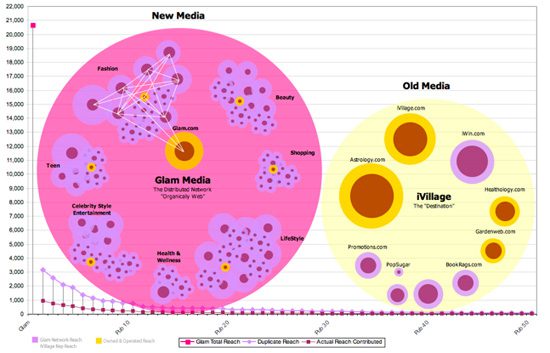
    The chart requires some explanation. Bear with me; it’s worth it.

    The yellow circle on the right represents iVillage, which had been the largest women’s site in the U.S. After only a year and a half, Glam has overtaken it as the new No. 1 with 23 million uniques (vs 18m for iVillage) and 600 million monthly pageviews.

    iVillage was our deadly competitor when I worked at CondeNet and we often sniped that much of its traffic was junk. This illustrates that: The largest circle inside iVillage is astrology traffic and the dark circle in that represents people who come to iVillage for horoscopes and nothing else. That may bulk up your traffic numbers, but it’s not saleable to advertisers. iVillage is built in the Yahoo model of sites it owns or controls; it tries to lure people in and then bombards them with ads.

    Glam, represented by the larger circle on the left, is a network. You’ll see clusters made up of smaller circles, representing their content areas: fashion, beauty, fashion, lifestyle, celebrity, teen. Inside each of those clusters, if you squint, you’ll see a small yellow circle. Those are Glam’s O&O (owned and operated) sites. All the many purple circles around those in each cluster represent outside, independent blogs and sites in Glam’s network. That is the secret to Glam’s quick growth without the cost and risk of doing everything itself.

    Glam finds the good blogs and creates a relationship. It features good content from them on Glam and also sells ads on the blogs, sharing revenue with and supporting those bloggers. It now has about 400 publishers creating about 600 sites and Arora said that some make multiple six figures a year. They’ve fired only one.

    Glam exploded by being a network. It asked the question, WWGD? What would Google do? Google, by the way, earns about 30 percent of its revenue through its O&O properties, Arora said. [LATER: See Capn Ken in the comments for more complete figures.] Glam earns 20-25 percent through its O&Os. Arora claims an advertising CPM of $15-35 for the O&Os and $8-15 for the network ($50-120 for the dreaded advertorial). Arora brags that they are “100 percent transparent” in their ad network, unlike someone else we know.

    So Glam is a content network. But they don’t create all the content. They curate it. So we should curate more as we create less. That’s another way to say what I’ve said other ways: Do what we do best and link to the rest. Also: We need to gather more and produce less, so we also need to encourage others to produce more so we can gather it. That’s a festival of PowerPoint lines there.

    Glam is also and advertising network that supports the creation of content. That’s how you encourage others to produce more.

    So in the end, Glam is really a platform. That’s the key.

    Glam is a rare example of that and I say other media companies would be wise to follow suit. A few days after meeting Arora, I also met Adam Bly of Seed magazine and ScienceBlogs. It’s a bit different, in that they curate the best science bloggers but then put them wholly on the ScienceBlogs platform. They sell ads and some of the science bloggers can make good money (not as good as those Glam figures but still good for a science academic; high fashion pays better than high science). And this allows Bly to build more around that (more on that later).

    So in addition to asking what would Google do, I say that media companies should be asking what Glam would do. WWGD, the sequel.

    : LATER: A platform, indeed.

    I’d been sitting on this post, not quite done with it, and it so happens I published it coincidentally with previously embargoed news that Glam is starting a network for Lifetime. From the press release:

    The new Lifetime Glam network will expand upon each company’s position as #1 for women — in TV and online, respectively. Today’s announcement is part of Lifetime’s broader expansion of its digital business including the relaunch of its website as http://www.myLifetime.com. As part of the agreement, both companies will also syndicate content – including a Glam-powered Beauty & Style channel on Lifetime’s website and Lifetime’s broadband video, games and other original content on Glam.com. . . .

    The Lifetime Glam distributed media network will be built on the new Glam Managed Vertical Network platform -designed to manage display advertising and content distribution for media companies. Glam’s new platform offering enables large media companies like Lifetime to rapidly create their own vertical distributed media networks in collaboration with Glam.

    That’s thinking like a network. That’s smart for both.

    : LATER: Michael Arrington argues with my argument. More on that above.

    : UPDATE: Glam just sent me better figures on them v. Google: “30-40% of Glam’s revenue is O&O, and 20-30% of Glam’s impressions are O&O . . . . 30-35% of Google’s Impressions are on Google.com, 60-50% of Revenue is Google.com vs its network.”