Tag: newbiznews

  • Slope slipperier

    Alan Mutter, chronicler of the decline of newspapers, has a good bit of context on the accelerating decline of newspaper circulation.

    Based on the record 3.5% drop in daily circulation reported today for the nation’s largest newspapers, it appears that average daily circ this year will be no better than 50 million. If so, that would be the lowest level since 1946, when daily sales averaged 50.9 million, according to statistics provided by the Newspaper Association of America.

    Though circulation has fallen back to pre-Baby Boom levels, the population has more than doubled since 1946. If you divide circulation by population, you will find that fewer than 18 out of 100 Americans today buy a daily or Sunday newspaper. Back in 1946, 36% of the population bought a daily paper and 31% took a Sunday edition.

    While newspaper circulation has weakened since the 1980s, the decay has accelerated sharply since 2003, as illustrated in the chart below. Sunday circulation, which had been relatively more resilient than daily sales, now is falling more precipitously than daily sales. In the six-month reporting period ended on March 31, 2008, Sunday circ fell 4.2%, nearly a full point higher than daily circ.

    For contrast, 121 million Americans voted in the 2004 Presidential election, 97.5 million Americans watched the SuperBowl, there are 40 million black Americans, 37 million Americans watched American Idol last year.

  • Birthin’ Barista’s babe

    I’m proud to say that this is one of the outcomes of the Networked Journalism conference at CUNY last fall:

    exploremontclair_headlineimage.jpgBaristanet and the Star-Ledger are joining to create a cobranded print guide to the Barista’s turf, Montclair, NJ, with content from both partners, Star-Ledger distribution, and shared effort on the advertising.

    So a blogger and a newspaper are making business together. Bravo.

    Debbie Galant announces the birth today:

    Baristanet is again making news in the media world. This time, it’s our partnership with the Star Ledger (yes, the Star Ledger!) to create a print guide to Montclair. Last week, Baristanet founder Debbie Galant and Star Ledger editor in chief Jim Willse spoke about the partnership to a group of newspaper and web editors from all over the world.

    The official matchmaker was new media evangelist Jeff Jarvis, who suggested the partnership during his Networked Media Summit in New York last October.

    The co-branded 36-page “Explore Montclair” guide will have stories by Baristanet and the Ledger, and even a special Montclair crossword puzzle by Tony Orbach. It goes out to 70,000 readers on May 15. If you’re not a home subscriber, you’ll be able to pick it up at the Montclair Public Library and many other locations (more on that later.)

    The ad reservation deadline is tomorrow. If you want to underwrite history, let us know right away.

    I did suggest the partnership as I played Oprah during Q&A in a session at the conference. But Debbie and Jim Willse both rejected the idea of starting online. They came up with the idea of a print guide with Barista’s cool attitude and the Ledger’s stores of information.

    I am delighted that they recognized their complementary assets and goals. Barista has its unique local knowledge and voice as well as its reputation in town and online (including with hyperlocal advertisers). The Ledger has the power of its infrastructure — printing, distribution, ad sales — and its reporters and archives as well as its brand and reputation. To compete would be silly and destructive. To cooperate, they can build something together they couldn’t build as well apart.

    This is thinking like a network.

    (Disclosures: I also sat in on their meetings. And I used to work for and still work with the Ledger’s parent company.)

  • Newspapers and change

    Change in newspapers — upgrading, updating, inventing, innovating — should be celebrated, no matter what causes it. See the story of the Madison Capital Times shifting — “reluctantly,” says the NY Times copy editor — from print, 90 years after it was first printed, to the web. Bravo, I say. This is the kind of bold move the American newspaper industry should have made five years ago, when they easily could have foreseen this future. The public is online, the new means of gathering and sharing news is online, the medium is more efficient and cheaper to run, the old business model is shot. Why wait? Yes, I sympathize with the staffers who lost their jobs, just as I sympathize with those on other papers who’ve lost theirs because their managements have not been strategic and brave and have not retrained them (or to put the responsibility where it better belongs, they they haven’t retrained themselves). But every newspaper in America should be delighted this is happening and should be watching it closely to see what works and what doesn’t. I think Jay Rosen shares this view as he reports on the shift and gives good advice to the former paper’s editors:

    * I know this isn’t how they’re thinking about it in Madison, but from my perspective Saturday marked the debut of a local newsblog and opinion site in Madison with an editorial staff of 40, and a web-to-print engine that is ready to start clicking. Those are basically good facts for the Cap Times. It’s up to the staff to bring journalistic imagination equal to them. . . .

    * If I were Paul Fanlund, the editor of the Cap Times, I would set a first year goal of developing 400 solid contributors of news, expertise and opinion able to work with my 40 pros at headquarters, and I would calculate that to get the 400 I would need a to register about 4000 participants in various networked journalism projects.

  • The press becomes the press-sphere

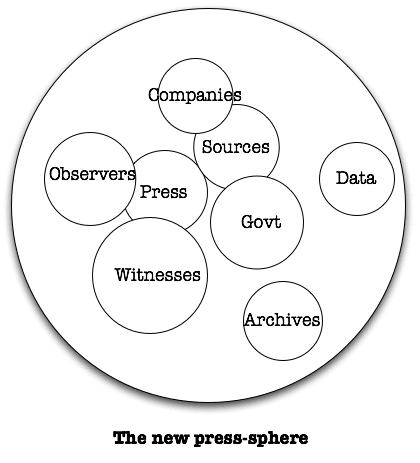
    One problem I’ve had with much discussion about the future of news lately is that it’s too press-centric. It focuses on the press as if it were at the center of the world, as if it owned news, as if news depended on it, as if solving the press’ problems solves news. That’s not the ecosystem of news now. There’s a fundamentally new structure to media and there are many different ways to look at it. And until we realize that, I don’t think we’ll begin to create successful new models for news. So pardon my simplistic drawings, but here’s an attempt to begin to illustrate that new ecosystem of news and media.

    We start, of course, with the way things were: news through the filter of the press to us with few other options. We all know this chart:

    mediachart1.png

    This is replaced today by a press-sphere in which any of many sources can, thanks to links, add up a story and to fulfilling the need or desire for news and information. The press may be involved and may create a news story. But we might have found that via links from our peers who tell us it’s news (“if the news is important, it will find me”). Either of those might have linked to source material from a company or government site — which now plays a press role in adding to the whole of a story. Witnesses can join in the process directly. Background might come via links to archives. Commentary from observers may add perspective. An accumulation of data may alert us to news or augment it. All of these elements add up to news.
    mediachart2.png

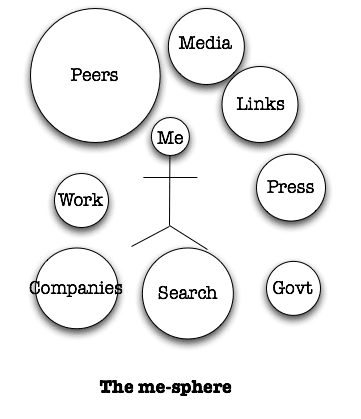
    When we put the public at the center of the universe — which is how these charts should be drawn and how the world should be seen, as each of us sees it — we see the choices we all call upon: the press still, yes, but also our peers, media that are not the press (e.g., Jon Stewart), search, links, original sources, companies, the government. It’s all information and we curate it and interact with it with the tools available. And, again, the press stands in a different relationship to the world around it.
    mediachartme.png

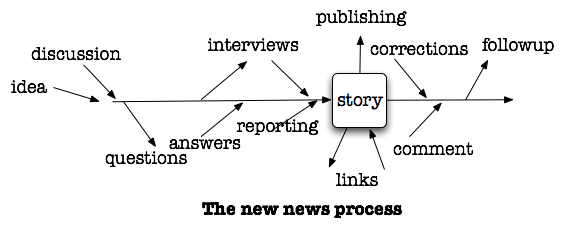
    So this yields a different view of the news story itself. The notion that news comes in and stories go out — text and photos come in and paper goes out — is an artifact of the means of production and distribution, of course. Now a story never begins and it never ends. But at some point in the life of a story, a journalist (working wherever) may see the idea and then can get all kinds of new input. But the story itself — in whatever medium — is merely a blip on the line, a stage in a process, for that process continues after publication.
    mediachartprocess.png

    When I was talking with the Guardian about their new newsroom, I saw two views of news in 3-D relief: In print, the process leads to a product. Online, the process is the product.

    This has an impact on how a newsroom and the journalists in it see themselves and their relationship with the public, over time. It calls into question the organizing principle of newsrooms. It used to be that we were organized around sections — news, sports, business… — and job descriptions — reporter, editor, photographer, designer. Then along came online and we were organized around media — print, online.

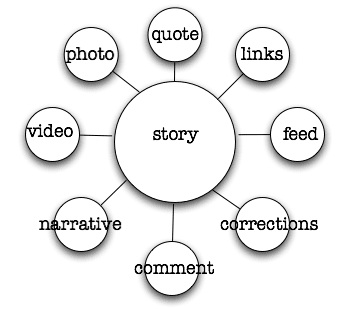
    But in this new ecology, I think newsrooms will need to be organized around topics or tags or stories because the notion of a section is as out of date as the Dewey Decimal System (hat tip to David Weinberger).

    Stories and topics become molecules that attract atoms: reporters, editors, witnesses, archives, commenters, and so on, all adding different elements to a greater understanding. Who brings that together? It’s not always the reporter or editor anymore. It can just as easily be the reader(s) now.
    storychart.png

    Of course, these aren’t the only architectural changes. Last week, I joined a discussion with the faculty at CUNY about these shifts, which included these ideas:

    * The separation of content from presentation on web pages means that design, navigation, brand, and medium can change and are not necessarily controlled by an editor’s design.

    * Feeds also have an impact on — and can reduce the value of — packaging and prioritization (also known as editing).

    * Live reports from witnesses also reduce the opportunity to package and edit.

    * The ecology of links motivates us to do what we do best and link to the rest. It fosters collaboration. It changes the essential structure of a story (background or source material can be a link away).

    * Links also turn our readers into our distributors.

    * Links turn our readers into editors.

    * Aggregation, curation, and peer links become our new newsstand.

    * Search and SEO motivate us to create repositories of expertise (topic pages) and make news stories more permanent.

    * Search reduces the power of the brand.

    * We see ourselves not as owners of content or distribution but as members of networks.

    * These networks can be about content, trust, interest, or advertising relationships or all of the above.

    I could keep drawing bad charts all day to illustrate the new network, reverse syndication models, the audience as the network, and more. I’ll spare you. (But if you have any charts to show, please do send links.)

    These are all fundamental shifts in how news and the world around it is constructed. So to keep talking about newspapers as if they were news is far too limiting in the discussion. It’s bigger now. It’s more complex. It moves over time. It’s more about process than product. It has no limit of sources and handlers and distributors and curators and perspectives. When we rethink this ecology of news, we’ll be in a better position to plan for what’s next.

  • Same old same old

    I’m frustrated these last few days by the discussion online about newspapers and the future of journalism. It’s just such a retread.

    Britannica’s blog — yes, even they have a blog — invited a handful of commentators to pontificate, doling it out as if it were a newspaper series (remember them? they were kinda like miniseries, only in black & white). What I want to hear is ideas for the future, not restating of the problem or the worries, but that’s mostly what we got. Nick Carr led it off with his predictable lamentation about change. Jon Talton — apparently a computerized algorithm with a name — recycled every blog complaint since 1999. Well, that’s helpful. Jay Rosen wondered about business models, which is on point (though the Britannica people, with their access to all the world’s wisdom, might have wanted to bring in some economists and business geniuses to try to answer his questions). At least Clay Shirky pushed for experimentation. And even former Tribune columnist Charles Madigan, after issuing what he seems to think is a required snark about the audacity of citizens daring to speak, has some ideas (he wants to make money for a free print paper by charging people to make wedding videos, arguing that it’s so hard to learn; I hereby invite Charlie to a CUNY class where we’ll teach him in no time). But it’s just so old, not moving the peanut down the street.

    Meanwhile, friends Chris Anderson and Howard Weaver find kismet arguing that the state of the newspaper business isn’t as bad as some say. Well, a discussion of how bad bad is isn’t terribly helpful, either. What we need is discussion of ideas and action.

    We must move past this pining for the past and shrugging about the future. We also have to stop seeing newspapers as the center of the news universe. More on this later.