Tag: journalism

  • The problem with “takes” is the business model of mass media

    A very good take on why all news organizations think they “need a take on that” becomes a self-fulfilling prophecy, being followed by another take and then another take on the Awl’s take on takes. Shoot us all now.

    No, shoot the business model and the presumptions of mass media economics. That is what is causing this ridiculous treadmill of making content for content’s sake to get audience for audience’s sake with any original reporting or original thinking being copied and copied again and again until it looks like a the fuzzy, unreadable, 87th Xerox copy of a bad carbon copy. That is what makes media companies think the answer to any business problem is to make more content because that’s what we content makers do.

    The problem is that the old business model of mass media rewards volume not value. The problem is also that we mistake our job as content makers rather than as service providers.

    Advertising is bought on eyeballs by the ton — that is, every 1,000 set of eyeballs a media site can deliver. Advertisers then deliver their messages to said eyeballs. That’s because that’s the way old, one-way, mass media had to work. That’s all that print and broadcast allowed. And we are still, two decades after the introduction of commercial web, trying to copy our old business models in a new media reality. Spoiler: It won’t work.

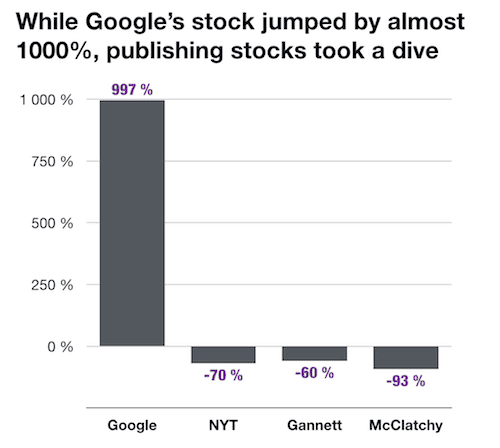
    Why do you think, as illustrated in this handy chart provided by First Monday, that Google’s value has soared 1,000 percent in that time while news media companies’ value has swirled down the toilet bowl?

    monday note chart

    Easy: Google sells value. To users, it provides relevance. To advertisers, it promises performance. Meanwhile, media still sell mass. They deliver one-size-fits-all products (“come see our home page, all of you; we’ll bet one of the hundred or so headlines there will grab you!”) to users. They deliver mere impressions to advertisers. Shouldn’t we be asking [cough] what would Google do?

    There’s another reason that journalists like to issue their own takes on takes: ego. Back in the day, reporters were assigned to “match” other publications’ reporting not because they were scientists replicating others’ research and adding value to it but mostly because they wanted their own bylines and their on brands over their own stories in their own pages. And that made a modicum of sense in paper economics. But it doesn’t make sense anymore. Indeed, we cannot afford to use precious journalistic resources parroting what others have already done, reporting what our readers already know. The net — as distinct from mass media — rewards specialization and quality, the thing people link to because it’s good. Quality. Value. As a dividend, the link also brings news organizations the opportunity to recognize efficiencies by not trying to do everything for everyone. Dare I repeat this, too: Do what you do best and link to the rest.

    The lessons of this story are painfully obvious: Stop making content. Start delivering service and value. Stop copying others’ work. Link to it. And to advertisers: Stop buying impressions. Buy performance. And to all: Challenge old assumptions. Innovation over inertia. Value over volume.

    So was this just another take on the takes on takes? So shoot me.

  • What could social journalism do for Ferguson?

    It took too long, but finally the attention of American journalism turned to Ferguson. Is the crush and focus of network cameras and big-paper reporters helping Ferguson or exploiting its struggle? The answer to that is obvious; see, for example, Newtown.

    The better, more constructive question is: How could journalism help the residents of Ferguson?

    The rationale behind our new, proposed M.A. in Social Journalism at CUNY — the thinking behind my argument that journalism must see itself as a service — is that journalism should start by listening, not speaking. It should start with hearing the needs of a community and then and only then deciding which tools to bring to bear to help a community meet its goals and improve its lot: reporting, explanation, education, convening, connecting, organizing.

    As I try to apply these notions to Ferguson, a few observations:

    It is, of course, possible now to listen in so many more ways. I was struck by this tweet that pictured community talking points about Michael Brown.


    When I retweeted that, a journalist objected that this is from an advocacy organization. Well, yes, of course. This group speaks for some people. The first question is: For whom does the organization speak? For whom does it not speak? What are the goals of the various communities in the town? Where are their disagreements? What in their discussion is correct? What is incorrect? What questions does the discussion raise? What information is missing? How can journalism help answer those questions? This document is a helpful starting point.

    See, too, this post by a teacher in Greece advising members of a community — whether Ferguson or the Gaza Strip — how to use the tools now at their disposal to affect the conversation: don’t rely on or trust mainstream media but still cultivate them; use your own networks to distribute your own content; use Creative Commons to control use of your content in media. Now some would say that is the community as not only advocate but as flack: media manipulator. Of course. But that’s a mediacentric way to look at this. See it from the community’s perspective and it’s a statement of power: We have a voice at last.

    There are more ways to listen to communities now because communities have a voice and ways to be heard. But the social journalist cannot just sit back and hear what people are saying on their blogs, in Twitter, and in their press conferences. The social journalist must also talk with the people who aren’t speaking and listen to them, asking them what their goals and needs are, what they know and don’t know and want to know and why.

    When I posed my first question above — about service v. exploitation — on Twitter, I got a response from a resident of Ferguson:

    But then I realized I was asking the wrong question and so I probed more:


    That is telling. But the conversation is still mediacentric, not communitycentric, telling the world about Ferguson rather than serving the people of Ferguson. So I keep asking:

    I asked whether reporters had asked him questions. He said no but was confident they would. Indeed, they did — though from Spain:

    My conversation with Mr. McCleery never left media: telling Ferguson’s story outside Ferguson. But what about telling the stories that will help Ferguson? It’s clear that showing up on someone’s doorstep and asking them what they need — “Hello, we’re corporate and we’re here to help” — is inadequate: journalism as focus group. This is why we will teach students to understand communities as best they can before they engage. They will use the tools I’ve listed above plus data skills to do that. But that is not sufficient. They will go meet people in the community — geographic or demographic, built around interest or event — and listen before speaking. They will observe and discern the community’s goals without imposing their own. That is why we think that social journalism must bring elements of social anthropology and community organizing to the task.

    But what will be hardest to teach — what is hardest for me to learn — is tamping down the journalistic reflex to start with the assumption that we know what’s needed and that our stories will meet those needs. As I watch the news in Ferguson, I can’t help but do what an editor does, imagining stories to assign: on, say, the racial composition of the town and its history and tensions, on prior cases of police brutality, on the politics of the town — who’s in charge and how does that match the composition of the community, and so on. We call that news judgment.

    But the truth is, of course, I don’t know Ferguson worth a damn. I don’t know what its needs are. I am in no position to decide how best to use precious journalistic resource to help them — let alone tell their story to the world.

    In classic journalistic structure, the best person to try to do these things is the beat reporter, whose first job is to learn about the constituencies she covers, whether that’s a town or an agency or a topic. This is why I am working to grow the news ecosystems of New Jersey and New York with more beats; this is why we study their businesses at CUNY; this is why we are going to give intense training in running a beat business at the school this fall.

    But not every community is lucky enough to have a beat reporter dedicated to its coverage and needs. And beat reporters classically still operate as story machines because that’s all they could do and that supports the economics of their business. But now, in the age of the net and social media, there are so many more ways to not only publish (and promote) but listen, so many more ways to understand a community’s needs and meet them, so many more ways to see people as individuals and communities rather than as a mass served with a necessarily one-size-fits-all product we called news.

    It’s not going to be easy to turn journalism on its head, starting with listening rather than publishing, with serving the needs of a community over telling its story to others, and with judging one’s success on the community’s terms rather than media’s (those are the terms of service Jay Rosen has been challenging me to provide in this vision of service journalism).

    I don’t know what Ferguson needs. I know that the country needs to pay attention to what is happening in the town and so I’m glad that social media — that is, people using social media to report what they witness — forced Ferguson’s issues onto national media. I also know that it won’t be long before the town will get sick of that attention and of the sensationalism that will emphasize everything bad about Ferguson and nothing good: simple stories that can be told in 1:30 of time or 13″ of type. I also know that when the reporters leave Ferguson’s McDonald’s and the satellite trucks rumble off its streets, then Ferguson will be left little better off for all the journalism that occurred there. It will still have needs and goals and could use help to meet them. That is where social journalism begins.
  • Absolution? Hell, no

    sarducciovalThe good Reverend David Carr grants us absolution. “So whose fault is it?” he asks after chronicling the excommunication of newspapers and magazines from media companies casting off their old, print ancestors to starve and die. “No one’s,” Carr decrees.

    Not so fast, preacher. It is our fault. Who else could be at fault? We journalists, publishers, and journalism schools have turned out to be irresponsible stewards of journalism. We squandered our trust and our cash flow. This was was our institution to nurture and protect and Carr says it’s all but dead.

    Wait a minute, Father David. That depends on what you define as our institution. He sees it as print. Well, hell, I’ve spent years now begging my journalistic coreligionists to stop defining themselves by their medium — by their means of production and distribution — otherwise they’d all end up just where they are today: the baby swirling down the drain with the holy water.

    But there was good news for media companies this weekend, wasn’t there? BuzzFeed got a $50 million investment from Andreessen Horowitz. I thought venture capitalists didn’t invest in content because it has cooties, no? But its new board member, Chris Dixon, says that’s because BuzzFeed’s not a media company. “We think of BuzzFeed as more of a technology company.”

    cat baptismWell, hold on, you moneychanger in the temple, you (and mind you, sir, we’re glad to have you here; please make yourself at home). BuzzFeed is still a mass media company because it still operates by mass-media economics based on volume: the more people it can tempt into its harem with the siren call of its cats, the more people it can serve to advertisers (no matter what it calls its advertising). It is a last-gasp, clever (some might say cynical) exploitation of those old-media ways, grabbing the last dollars from the cold, dead hands of Carr’s congregation. It is the newest old-media company.

    But I have faith that BuzzFeed’s founder, Jonah Peretti, can invent his way out of this — that’s why Andreessen Horowitz is not nuts to invest in him. He can use the cash flow the old ways bring him to invent something new. But he hasn’t yet. And that’s the point: There’s still time. Old media companies still have cash flow they, too, should be using to reinvent themselves.

    But Brother Carr has renounced his vows right from inside the old scriptorium. Fucking Gutenberg. “Nothing is wrong in a fundamental sense,” he writes. “A free-market economy is moving to reallocate capital to its more productive uses, which happens all the time. Ask Kodak. Or Blockbuster. Or the makers of personal computers. Just because the product being manufactured is news in print does not make it sacrosanct or immune to the natural order.” Or how about asking Netflix?

    No, market forces are not an excuse for fatalism and ultimately suicide. Market forces are an opportunity for — forgive me, for I do know I’m getting carried away with this religion thing — resurrection. There is still time as no one has yet challenged all our old-media assumptions about content and print and reinvented journalism as what it should be.

    I’ve warned you that I’m about done with a 55,000-word tome about that reinvention. I’ll give you the tl;dr now: Journalism needs to rebuild itself as a service to individuals and communities, which requires having relationships with them as people, not a mass, helping them reach their own goals in new ways — not just with content — and sustaining this work with business models built on value over volume.

    That’s not what newspapers — even the digital-first among them — are yet. That’s not what BuzzFeed or Huffington Post or Business Insider or Vox is … yet. I don’t know what that is yet (thus my tome is no prophecy) but I suggest a few paths to the promised land.

    At the end of his eulogy, Carr writes: “It’s a measure of the basic problem that many people haven’t cared or noticed as their hometown newspapers have reduced staffing, days of circulation, delivery and coverage. Will they notice or care when those newspapers go away altogether? I’m not optimistic about that.” Ah, but it’s a poor shepherd who blames his sheep.

    So I’ll end this as good sermons should, with a charge to the congregation: Go forth and figure it out, people. Stop whining. Stop looking for excuses and forgiveness. Stop giving up. Your flock needs informing. Go find new ways to do that. And I don’t want to see your prodigal asses back in these pews until you do. That goes for us in the seminary, too.

    Amen.

  • Calling all entrepreneurial journalism profs

    If you teach or soon plan to teach entrepreneurial journalism, the Tow-Knight Center for Entrepreneurial Journalism — my colleague Jeremy Caplan and I — invite you to attend a day-long summit at the CUNY Graduate School of Journalism in New York on July 10.

    Our small, new field has grown like weeds. Dozens of journalism schools and foundations are now training and supporting the next generation of media leaders to report, edit, close sales, capture audiences, and run businesses. Our goal is to enable those of you who’ve pioneered these efforts — as well as those just getting into the field — to share best practices and common challenges.

    We plan to invite an expert from entrepreneurial education in another field to speak, and ask some of our former students to discuss their experience starting up companies. But on the whole, the day is about your lessons learned, concerns, and needs — and to see whether and how we should collaborate as a group in the future.

    Please register here if you plan to attend, or aren’t sure yet, but want to reserve a place. If you cannot attend, we will plan to stream the event and actively involve remote participants in the discussion. Watch this space.

  • The social journalism degree proposal

    Some have asked for more detail about the MA in social journalism we are developing at CUNY. Here are major excerpts from the formal proposal that I wrote (well-edited by our dean, Sarah Bartlett). I’m sparing you sections on the facilities. The syllabi will be works in progress until we bring on the faculty to teach the courses; I’ll share those later. As ever, I am eager to hear your thoughts and questions. Link to the Google doc here; PDF here.