• Wave and news

    When Google Wave was announced, I got all jittery-happy about the possibilities it presented for news. Now, from a Belgian site, via a German site, I find a video interview with Wave’s project manager, Stephanie Hannon, speculating about its use in news:

    Google Wave, une opportunité pour les journalistes ? from Labs RTBF on Vimeo.

    In that video, the interviewer asked about the newsroom moving to the cloud. But in this one, Sergey Brin says it’s already there:

    “Les rédactions sont déjà dans le nuages” Sergey Brin (Google President) from Labs RTBF on Vimeo.

  • Is journalism an industry?

    Journalism is a business – that is how it is going to sustain itself; that is a key precept of the New Business Models for News Project. But is it still an industry dominated by companies and employment?

    In the first part of his analysis of the news business, BusinessWeek chief economist Michael Mandel equates bad news about news with the number of journalists employed. He charts newspaper jobs falling from more than 450,000 in 1990 to fewer than 300,000 today and calls that depressing – which it is, if one of those lost jobs is yours. But it could also signal new efficiency and productivity, no? Looking at these numbers with the cold eye of an economist whose magazine and job aren’t on the block, perhaps it is nothing more than the path of an industry in restructuring. Perhaps it’s actually a signal of opportunity. Indeed, Mandel then laid that chart atop one for the loss of jobs in manufacturing and found them sinking in parallel, with newspapers just a bit ahead on the downward slope today. “Not good news, by any means,” he decreed.

    But there is the nub of a much bigger trend: the fall news as an industry paralleling the end of the industrial economy. That’s not just about shedding the means of production and distribution now that they are cost burdens rather than barriers to entry. It’s about the decentralization of journalism as an industrial complex, about news no longer being based solely on employment.

    A few months ago, I quibbled with Mandel’s BW cover story arguing that America has experienced an “innovation shortfall.” There, as here, I think he’s measuring the wrong economy: the old, centralized, big economy. In both cases, he misses new value elsewhere in the small economy of entrepreneurs and the noneconomy of volunteers.

    I return again to the NewBizNews Project, where we modeled a sustainable economy of news at between 10-15% of a metro paper’s revenue – about as much as any of them bring online – with an equivalent amount of editorial staffing but those people are no longer all sitting under one roof; they work in – and oftentimes own – more than 100 separate enterprises. I return, too, to the Wikimedia Foundation calculating the value of time spent on edits alone with it adding up to hundreds of millions of dollars.

    In both cases, tremendous value is created at tremendous efficiency outside of the company and in great measure outside of employment.

    So is employment the measure of news? No. Is it the proper measure for every industry? Not necessarily. Is it the measure of the economy? Not as much as it used to be. Media is becoming the first major post-industry. Others will follow. You just have to know where to look.

    * * *

    It’s one matter when new value is created outside old companies in industries such as retail – in WWGD?, I cited $59.4 billion in sales from 547,000 merchants on eBay in 2007 vs. $26.3 billion in 853 Macy’s stores – but another matter when the employment is replaced in industries built around priesthoods: journalism, education, even government and medicine. Then not just economics but behaviors change.

    Thus we see fretting about a “post-journalistic age” when new people perform some of the tasks journalism employees used to perform, whether that is advocates digging dirt or universities reporting their own scientific advances or sports teams funding their own reporting or volunteers organizing to report collaboratively. These are just a few of the latest examples from my pre-surgery tabs about voids being filled in new ways by new parties with new efficiencies. This is another reason it’s dangerous to calculate journalism’s size according to journalism’s jobs.

    : LATER: Here’s Roy Greenslade still basing his analysis on staffing. Perhaps the better analysis is investment.

  • The small c and the big robot

    Few of you should care but for those who do, here’s a chronicle of my experience in robotic surgery for prostate cancer. I post it here mainly for the ongoing Google value to those who follow me into the O.R.
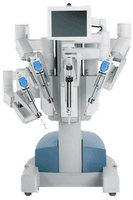
    da-vinci-robotAt 9a Monday, I walked into the bright operating room at Sloan Kettering and faced the robot. Pictures of it on the manufacturer’s web site make it look small, like something that might screw in radio knobs on a Cooper Mini: friendly. In person, the robot is huge, like something Sigourney Weaver would defeat in space: imposing. I saluted it and backed away. Its arms stood at ease, each covered in plastic to maintain its sterility. I also saluted the surgeon, Dr. Raul Parra, who works many feet away at a console that gives him a video view inside me – much magnified – and delicate control of the five arms poking inside my belly. They also pump me up with CO2 to give the robot room to work and the doctor room to see. One friend made reference to me becoming a Macy’s Thanksgiving Day Parade balloon and envisioned shooting me down over Broadway.

    The waiting-room nurse told my wife that they put patients under anesthesia an hour before surgery begins because that’s how long it takes to set up the robot and patients tended to get a little freaked seeing an alien beast assembled over them, ready to drill in. It’s one matter to be scared of needles, another to stare at a robotic arm with electric scissors on the end.

    While he’s inside, the surgeon tries to peel back and preserve the nerves that encase the prostate because they’re the ones that enable erections. In some proportion of cases, the patients get that magic talent back; in some cases, not. That’s why doctors now prescribe Viagra before and after (“use it or lose it,” another doctor said to me – a new answer to, “not tonight, dear, I have a headache”). The surgeon takes out the seminal vesicles, which means that orgasms, when and if they return, are no longer messy. Out go a few lymph nodes. And, of course, out goes the prostate and a piece of the urethra with it. That’s why men also have problems with continence. “We have to re-potty-train you,” said my doctor’s nurse.

    After surgery, the doctor said my cancer appeared to be contained to the prostate. That’s the key question. If it is, then my PSA – which was rising and led to the discovery of my cancer – should fall to nil. If it isn’t contained, then the cancer can spread to the bones (that’s what killed my grandfather) and then treatment could include radiation and hormones (to cut off the testosterone that feeds prostate cancer).

    When I woke up in full morphine-induced stupidity, I had five small holes in me – the largest just big enough to bring out the prostate – and two drains, one in my side (which was taken out before I left the hospital – a very eerie experience, having a foot-long french drain pulled out of your belly), the other where I had been dreading it. When I scheduled surgery, the nurse volunteered to show me a Foley catheter. I declined. Funny, she said, everybody does. In my mind’s eye, I saw a thin stick up my dick and that was bad enough. But I woke up to find a garden hose coming out of my penis (the subject of one of my earliest tweets once I got my iPhone and lucidity back). As the Howard Stern Show’s Gary Dell’Abate told me about his stent up there, the problem isn’t so much pain as feeling things move where they shouldn’t.

    I wrote a Guardian column about choosing to reveal my cancer on my blog and the benefits that come from it. There’s no greater symbol of giving up privacy and embracing publicness, I think, than writing about one’s penis, especially when it malfunctions. But in the hospital, I lost every last vestige of modesty. There’s just no point. Nurses need to fix things there and give instruction on how to cope with the catheter and you are completely, utterly exposed. There’s a young, female nurse, speaking at eye-level to my penis telling me what to do with it as it sits in extreme repose. Think Seinfeld’s shrinkage episode; cold water and catheters have the same effect. By Tuesday, my last bit of third-grade immaturity about the subject of penises died.

    Now I have to manage my catheter. Warning: appetite spoiler coming. As my wife said to the kids, “Daddy’s going to be disgusting for a few days.” I have to empty and change a bag strapped to my leg during the day and a bigger one that hangs by my bed at night (but it’s not big enough to get me through the night and let me tell you, you don’t want this thing to back up). As with all challenges, once you’ve faced it, it’s not as daunting as the dread.

    My pain isn’t awful, either. I have enough Vicodin to keep Artie Lange or House happy for a month but so far I haven’t used any, just one sleeping pill to date. It hurts my stomach to stand up and lie down – and, gawd, you don’t want to burp or cough and I don’t want to know about sneezes – but that’s momentary. It’s really not bad.

    If I had chosen radiation instead of surgery, I would not be dealing with problems of plumbing malfunctions now, but there’s a chance those could come in a few years. And it’s also not possible to be assured that the cancer is gone. There’d be more hanging over my head. So at my age, I’m still glad I chose this course: out, out, damned spot.

    I’m well aware how lucky I am. Prostate cancer can be cured; the treatment has its inconveniences but nothing next to so many other forms of the disease. Mine was caught early but my timing was good insofar as robots had been invented and perfected. My unit at Sloan Kettering was filled with nothing but prostate cancer cases like mine. My wife sat in the lobby and saw parents wheeling in a child’s dolls and books for a long stay. That’s what makes the place break your heart. My inconveniences are easily put into perspective.

    As I finish this post, it’s Thursday afternoon. I’ve slept through the night, avoided most plumbing disasters, just took a mile walk (at a crawl’s pace), am eating well, and have even had a first glass of wine. I’m probably doing better than I thought I would. One friend took over my class this week and another will next week, but in a fit of optimism, I hope to have my hose-ectomy on Wednesday morning and then go into the city for school that afternoon. We’ll see. In any case, it’s good to have cause for optimism.

    I’ll continue to update you on my condition, as warranted.

  • NewBizNews in the Guardian

    In addition to the podcast (below), the New Business Models for News Project is the subject of my column in the Guardian’s media section. Here’s the full text:

    There is a future for news – a sustainable and once-again profitable future with the prospect of expanding and improving journalism by taking it deeper into our communities with increased relevance, engagement, accountability and efficiency.

    A team of business analysts and journalists in the City University of New York Graduate School of Journalism’s New Business Models for News Project, which I direct, tried to answer the hard questions that have been asked since news organisations began suffering business challenges – and more recently, bankruptcy. Namely: what happens to journalism in a city when its last daily newspaper dies?

    Or to put it another way: will there be a market demand for journalism? Can the market meet this demand? And who will pay for the journalism we need? These are business questions and so we sought business answers in research with a wide range of news companies.

    The most startling and hopeful number we found is this: some hyperlocal bloggers, serving markets of about 50,000 people, are bringing in up to $200,000 a year in advertising. These are sustainable businesses and we believe they are critical elements of the future of local news – a future no longer controlled by a single newspaper but instead by an ecosystem made up of many players with varying motives, means and models, working collaboratively in networks.

    We see the faint beginnings of this ecosystem today in the 10,000 hyperlocal bloggers who operate in the US, according to the hyperlocal network outside.in. They are being joined, almost daily it seems, by unemployed professional journalists intent on continuing to report and eating while doing so – for example the New Jersey Newsroom, the Ann Arbor Chronicle, and My Football Writer in Norwich. At CUNY, we surveyed more than 100 of these local-site proprietors and some are becoming profitable.

    Keep in mind that few, if any, of these bloggers and journalists have experience in business, advertising or sales. So in our project, we suggest that there are many ways to optimise their businesses. Start by improving the products and services they offer to local traders. Then add the potential of regional advertising that will need outlets when the metro paper dies, as well as smaller networks made up of a few towns or built around interests such as parenting or sports. We even see potential for e-commerce revenue, following the example of the Telegraph, which sells hangers and hats, and now Utah’s Salt Lake Tribune, which has begun selling homes.

    Bottom line: after three years, we project that a blogger could hire editorial staff and advertising help – citizen salespeople who help support the citizen journalists – and net $148,000 out of $332,000 revenue. That’s a conservative estimate when you consider that a community weekly paper in such a town probably earns between $2m-$5m.

    We still see a role for a news organisation – the successor to the newspaper newsroom – that covers city-wide stories, provides the best reporting that will remain the lifeblood of local journalism, and works collaboratively with many in the community. It is the largest member of the ecosystem but with a staff of 100 instead of 1,000 – and without the cost of printing and distribution – it is much smaller than the old newspaper and that is what makes it profitable. In the US, we have seen not-for-profit versions of this new news organisation rise in San Diego, Minneapolis and New Haven.

    There are more contributors to the metro news ecosystem: technology and sales support organisations that enable these players to operate as part of ad and content networks; publicly supported and not-for-profit entities (public media, an individual reporter supported by pledges using services such as spot.us, or a foundation-supported organisation); transparency of government actions and information (which we believe is critical to enabling any citizen to become a watchdog); national networks and the immeasurable but invaluable force of volunteers who contribute to public knowledge, because they care.

    Adding this all together, our models projected editorial staff of 277, equivalent to a current newsroom in our hypothetical city of 5 million but now highly distributed among many new entities. We forecast total revenue totalling 10%-15% of that of the newspaper – which is about what most papers earn online today. At that level, we see sustainable journalism of scale but we also see great potential for growth, especially if journalists learn to take advantage of the social engagement the internet enables.

    Ours is only one optimistic vision. There is no way to tell if we are right until journalists, business people, advertisers, technologists and citizens invest in the future instead of merely trying to protect their past. The incumbents are talking about building pay walls. Google has just offered its Checkout payment system to enable micropayments – which may be less of a rescue for papers than for the rare unpopular Google feature. Meanwhile, the entrepreneurs we interviewed are building new news companies for the new ecosystem.